

- Home
- Companies
- Earth Shield Environmental Co., Ltd.
- Articles
- Geosynthetic Clay Liners are used in ...
Geosynthetic Clay Liners are used in Irrigation Canals, Reservoir Dams, and Landscape Lakes
What is a Geosynthetic Clay Liner?
A geosynthetic clay liner (GCL) is a type of geosynthetic material specifically used for waterproofing and leak prevention in artificial lakes, landfills, underground garages, rooftop gardens, swimming pools, oil depots, and chemical storage facilities. It consists of highly expansive sodium bentonite clay sandwiched between a specially designed composite geotextile and a non-woven fabric. The needle-punched bentonite liner creates numerous small fiber spaces, preventing the bentonite particles from flowing in one direction. When exposed to water, it forms a uniform, high-density, gel-like waterproof layer within the liner, effectively preventing water leakage.
Bentonite’s mineralogical name is montmorillonite. Natural bentonite is mainly divided into two categories based on its chemical composition: sodium-based and calcium-based. Bentonite has the characteristic of swelling when exposed to water. Generally, calcium-based bentonite expands to only about three times its original volume, while sodium-based bentonite absorbs five times its own weight in water, expanding to 15-17 times its original volume. By locking the sodium-based bentonite between two layers of geosynthetic materials, protection and reinforcement are provided, giving the GCL a certain overall shear strength.
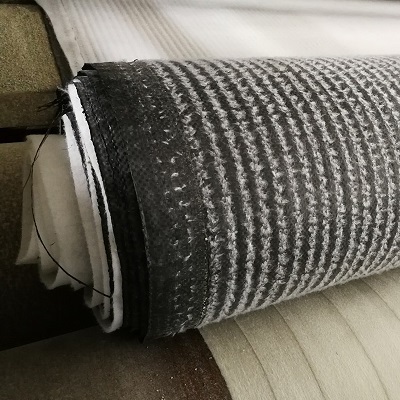
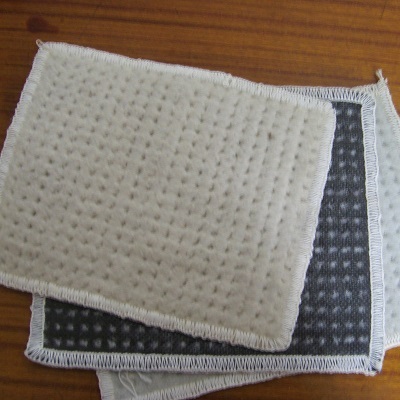
- Excellent compactness: Sodium-based bentonite forms a high-density diaphragm under water pressure. At a thickness of approximately 3mm, its permeability is less than 10?¹¹ m/sec, equivalent to 100 times the compactness of 30cm thick clay, and it possesses strong self-water retention properties;
- Strong self-healing ability: Potential leaks or cracks can be automatically healed through the self-migration of bentonite;
- Resistance to dry-wet cycles and freeze-thaw cycles: The permeability coefficient does not change significantly after continuous dry-wet cycles and freeze-thaw cycles;
- Simple and fast construction: Compared with other waterproofing materials, construction is relatively simple and requires no heating or gluing. It only requires connecting and fixing with bentonite powder, nails, and washers. No special inspection is needed after construction, and any waterproofing defects are easy to repair. GCL has the shortest construction period among existing waterproofing materials;
- Not affected by temperature: It will not become brittle even in cold climates.
- Integration: Integration of waterproofing material and the object: Sodium-based bentonite has an expansion capacity of 20-28 times when it encounters water. Even if the concrete structure vibrates and settles, the bentonite in the GCL can repair cracks on the concrete surface within 2mm.
- Bentonite is a natural inorganic environmentally friendly material, harmless to humans and the environment, and has no special impact on the environment, possessing good environmental protection properties.
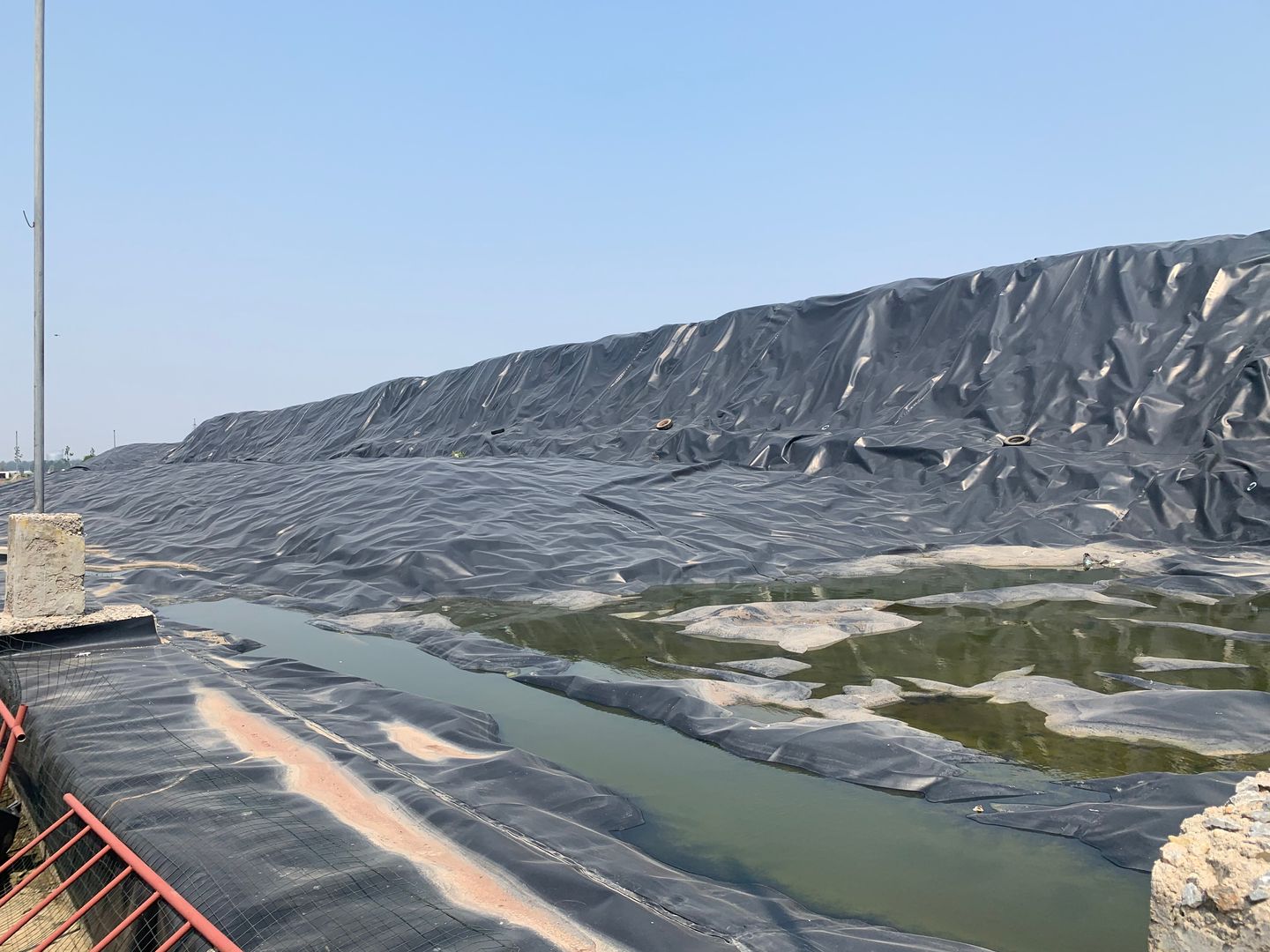
Geosynthetic Clay Liners are widely used in irrigation canals, reservoir dams, reservoir capacity, and landscape lakes. Geosynthetic Clay Liners have a large self-weight and a certain thickness, so leaks and defects are unlikely to occur. Even if they do occur, they are easy to detect and confirm, and repairs are simple. Geosynthetic Clay Liners also have the function of automatically repairing cracks. Natural sodium-based clay is not prone to aging and will not suffer from freeze-thaw damage, saving on future operation and maintenance costs.
- Underground structure waterproofing: Such as waterproofing of the base and side walls of basements, underground garages, tunnels, and subways, effectively preventing groundwater intrusion.
- Water conservancy projects: Used for seepage control in artificial lakes, reservoirs, canals, and landscape water bodies, reducing water resource loss.
- Environmental engineering: Used as an anti-seepage liner in projects such as landfills and tailings ponds to prevent pollutants from seeping into the ground and protect soil and groundwater environments.
- Municipal engineering: Can be used as a root-resistant waterproof layer for rooftop gardens, or as a waterproofing measure for various underground pipe corridors.
Tips: Although Geosynthetic Clay Liners have superior performance, their limitations should still be considered in practical applications. They are not suitable for projects that are continuously immersed in strong acid or strong alkaline environments, as extreme acidity or alkalinity may affect the swelling performance and long-term stability of the bentonite. Under conditions of high dynamic water pressure, there is a risk of gradual erosion and loss of bentonite particles, requiring corresponding protective measures. Backfilling and subsequent operations after construction require careful management to avoid irreversible damage to the installed waterproof layer.

- Seepage Control in Irrigation Canals
Core Objective: To reduce leakage losses during water transport, improve water resource utilization efficiency, and prevent soil salinization or waterlogging on both sides of the canal.
Application Characteristics:
Laying Method: Usually laid on the slopes and bottom of the canal. Particularly suitable for small and medium-sized canals.
Structural Requirements: Requires an appropriate protective layer (such as backfill soil, sand and gravel, or precast concrete slabs) to prevent erosion by water flow, UV aging, and damage from plant and animal roots.
Advantages: Quick construction, strong adaptability to foundation deformation, and very suitable for long-distance canal projects with varying terrain. Lower cost than concrete lining, and better seepage control effect than compacted soil.
Precautions: Proper overlapping between GCLs and sealing with auxiliary structures (such as gates and culverts) must be ensured. In canals with high flow velocities, the protective layer must be stable and reliable. - Seepage Control in Reservoirs and Dams
Core Objective: As part of the dam’s seepage control system (usually as an auxiliary or secondary defense line), to reduce leakage of reservoir water through the dam body or foundation, ensuring dam stability and safety.
Application Characteristics:
Application Location:
New Construction: Can be used as part of the vertical seepage control wall of earth-rock dams (suspended or enclosed type), or laid on the upstream slope of the dam as a liner.
Reinforcement and Repair: Often used for leakage treatment of existing earth-rock dams, laid in excavated trenches on the upstream face or dam crest.
Structural Requirements: In such critical projects, GCL is usually not used alone as the main seepage control body, but is used in combination with geomembranes (i.e., Geosynthetic Clay Liner composite geomembrane), forming a “double insurance” system. Design requirements are strict, and detailed seepage stability calculations are required.
Advantages: Good self-healing properties can cope with small cracks that may appear in the dam body. Compared with clay core walls, it saves space and earthwork.
Precautions: Extremely high requirements for foundation bearing capacity, laying flatness, and joint treatment. It must withstand high hydrostatic pressure for a long time, and its stability under water pressure must be ensured. 3. Seepage Control for Landscape Lakes/Artificial Lakes
Core Objective: To maintain the water level of the landscape body, prevent water leakage and loss, and reduce the cost and frequency of water replenishment.
Application Characteristics:
Ideal Choice: This is one of the most widely used and typical applications of GCLs.
Installation Method: Directly laid on the excavated and prepared lakebed, covered with a certain thickness of protective soil layer (usually 30-50cm of topsoil or sand), after which landscaping or the placement of pebbles and other decorative elements can be carried out.
Advantages:
Eco-friendly: Aquatic plants can be directly planted after covering with soil, which is conducive to creating a natural ecological landscape.
Adaptable to Deformation: It can adapt well to uneven settlement of the foundation, preventing cracking and leakage.
Fast Construction: Short construction period and significantly lower cost than reinforced concrete structures.
Precautions: Tree roots, sharp stones, and other foreign objects must be thoroughly removed before installation. Reinforced sealing treatment is required for detailed areas such as the lake shoreline, water inlets, and drainage outlets. If fish farming is planned, measures to prevent fish from burrowing should be considered.
Key technical parameters affecting the cost of bentonite geosynthetic clay liners (GCLs):
Cost differences mainly stem from product technical specifications:
- Bentonite content per unit area (g/m²): This is the most critical indicator, directly determining the impermeability performance and price. It typically ranges from 4000 g/m² to 6000 g/m² or higher. Impact on GCL price: Higher content (e.g., 5500 g/m²) results in higher material costs, suitable for high-demand projects such as landfills; lower content results in lower costs, suitable for low-head projects such as landscape lakes.
- Manufacturing process type:
Needle-punched method (GCL-NP): The most basic and economical. Two layers of geotextile are needle-punched to encapsulate the bentonite.
Needle-punched and film-laminated method (GCL-OF): Based on the needle-punched method, a layer of HDPE geomembrane is added, resulting in stronger impermeability and better puncture resistance, but at a significantly higher price than the ordinary needle-punched method.
Adhesive method (GCL-AH): Bentonite is fixed with adhesive. The price may be slightly lower, but the overall strength and hydrostatic pressure resistance are usually inferior to needle-punched products. - Raw materials and structure:
Bentonite type: Products using natural sodium-based bentonite (stable performance, high expansion index) cost more than those using artificially sodium-activated bentonite.
Carrier geotextile: Geotextiles with high strength and double-rough surface design (enhancing friction with the soil) cost more than single-rough surface or ordinary geotextiles.
Composite structure: If composite with a geomembrane is required, it will form an integrated high-performance product of “geosynthetic clay liner + geomembrane,” resulting in the highest price.
The cost of bentonite geosynthetic clay liners mainly depends on the “bentonite content per unit area” and the “manufacturing process.” Do not simply ask “how much does a bentonite geosynthetic clay liner cost,” but rather provide specific specifications based on project design requirements for a quotation.
At the heart of every water conservancy, environmental protection, or infrastructure project, waterproofing acts as a silent guardian. Geosynthetic Clay Liners, with their inherent natural intelligence—swelling upon contact with water and self-healing—make this protection even more reliable and long-lasting. We are committed to providing not just geotextile materials, but also waterproofing confidence backed by precise calculations and rigorous testing. Let us work together to build a more stable and durable foundation for your projects. Ready with your project specifications? Contact us today for an accurate quote and technical information, or visit our “Contact Us” page to learn how our products have been successfully applied in various projects worldwide.