


- Home
- Companies
- BioZyme Incorporated
- Articles
- Tightening the Calving Window in Beef ...
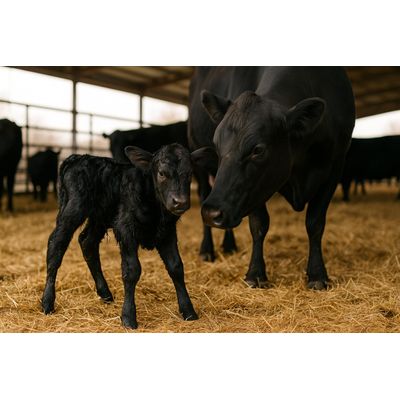
Tightening the Calving Window in Beef Cattle: An Integrated Reproductive Management and Nutrition Strategy
A shortened calving window is a profit driver, labor saver, and genetic accelerator. When calves are born within a defined, predictable period, uniformity improves, marketing options expand, and the production cycle becomes easier to manage. The most effective approach combines disciplined reproductive management with intentional nutrition. This integrated strategy tightens calving windows and compounds benefits over time.
Step 1. Define the Breeding Season
- You cannot tighten what you do not define.
- Establish a controlled breeding season to avoid open ended calving.
- Limit breeding to 45 to 65 days
- Turn bulls in on a set date
- Remove bulls on a set date
- For herds transitioning from year round calving, shorten gradually by trimming 10 to 15 days each year until the target window is reached
Step 2. Leverage Estrus Synchronization
Estrus synchronization aligns cows cycles so they come into heat within a narrow timeframe, focusing breeding early in the season, increasing early conception, improving first cycle pregnancy, and increasing calves born in the first 21 days. Common synchronization tools include prostaglandins, progesterone CIDR protocols, and GnRH based timed AI programs. When paired with artificial insemination, synchronization front-loads superior genetics and tightens the calving window.
Step 3. Strategic Use of Artificial Insemination
Timed AI programs breed a large portion of the herd within a defined 24 to 72 hour window, accelerating early pregnancies and increasing calves born in the first cycle. Benefits include greater genetic consistency, access to proven sires, improved calving ease selection, and a more uniform calf crop. AI followed by clean-up bulls maintains momentum and captures cows that did not conceive during synchronization. Use AI as a precision instrument rather than a broad brush.
Step 4. Evaluate Bull Power and Fertility
Even with synchronization and AI, natural service plays a role. Bull to cow ratio matters: commonly 1 mature bull per 25 to 30 cows, or 1 yearling bull per 15 to 20 cows. Bulls should have a body condition score around 6 at the start of the breeding season, depending on the cow ratio and other factors. Breeding soundness examinations are essential before turnout. Subfertile bulls can extend the calving season. Evaluate semen quality, scrotal circumference, structural soundness, and libido. Do not assume fertility; obtain veterinary verification.
Step 5. Nutrition as the Foundation
Reproductive technologies amplify performance, but nutrition remains foundational. Cows must calve in adequate body condition to cycle promptly. Target body condition score is 5 to 6 at calving. Key priorities include:
- Energy drives reproduction; forage testing and supplemental energy may be required late gestation and early lactation
- Protein supports rumen function, fetal development, and milk production
- Trace minerals copper, zinc, manganese, and selenium are critical for hormone function, embryo survival, and immune strength
- Vitamins A and E support reproductive health
VitaFerm is a line of nutritional supplements for beef cattle that maximizes energy and forage utilization and includes Amaferm as a prebiotic to increase digestibility. Feed concepts through product lines such as Concept Aid to promote breeding efficiency when fed 60 days pre calving through 60 days post breeding. For more fortified options, ReproMaxx products provide high vitamin and mineral fortification to support reproductive success.
Step 6. Manage Postpartum Interval
The postpartum interval, the time between calving and return to estrus, drives tight calving windows. Early calving cows have more time to recover; late calvers are disadvantaged. Strategies to shorten postpartum interval include ensuring adequate energy intake after calving, minimizing stress, maintaining mineral balance, and considering early weaning in extreme cases. Each day shaved from postpartum interval increases first cycle conception likelihood.
Step 7. Pregnancy Checking and Strategic Culling
For tight calving, accountability matters. Conduct pregnancy checks 45 to 60 days after breeding. Identify early bred, late bred, and open cows. Open cows should be culled; late bred cows warrant evaluation. Over time, retaining only early conceiving females reshapes herd fertility.
Step 8. Heifer Development Is Critical
Replacement heifers influence long term calving distribution. Heifers should reach 55 to 65 percent of mature body weight before breeding, cycle prior to the breeding season, and be bred to calve 2 to 3 weeks ahead of mature cows. Early calving heifers are more likely to remain early calvers. Nutrition during development is critical; underdeveloped heifers struggle to conceive and may drift later in subsequent seasons.
Step 9. Monitor Calving Distribution Data
Track calving data to inform management decisions. Some producers use notebooks, others use digital tools; the key is consistent data collection. Track:
- Percentage calved in the first 21 days
- Percentage calved in the second 21 days
- Total calving span
- Weaning weights by calving group
Many high performing herds target 60 percent or more of calves born in the first 21 days.
Step 10. Align Nutrition with Reproductive Protocols
Reproductive technologies increase precision while nutrition drives biological readiness. Align mineral supplementation 60 to 90 days pre breeding and from 60 days pre calving through 60 days post breeding with VitaFerm products. Strategic energy supplementation before synchronization, rumen-supportive feed additives during the breeding season, and immune-supportive nutrition during late gestation support the synchronization and conception process. Healthy rumen function improves nutrient absorption and hormone production, which regulate estrus and conception.
The Compounding Effect Over Time
The first year of tightening the calving window may feel like an adjustment. The second year shows improvement. By year three, momentum builds. Early calving cows produce early-born replacement heifers that, if developed properly, conceive early. This cycle reinforces itself. A uniform calf crop improves marketing options, reduces labor spread, and coordinates vaccination, branding, and weaning as integrated processes rather than scattered tasks.
Premium Nutrition is Key to a Tighter Calving Window
Integrating quality nutrition with VitaFerm supplements powered by Amaferm is the first step to maximizing reproductive success. Amaferm is a proven prebiotic that enhances digestibility of feeds and forages, ensuring the herd utilizes what is consumed. Concept Aid products promote effective, easy breeding when fed 60 days pre calving through 60 days post breeding. For advanced mineral needs, VitaFerm ReproMaxx provides high vitamin and mineral fortification for reproductive success.
VitaFerm Offers Choices
Concept Aid and ReproMaxx offer multiple formulas to tailor to the cattle breeding program. In addition to Amaferm containing formulas, VitaFerm also offers formulas with organic copper, iodine, zinc, and high vitamin E. Options address challenges such as heat stress in gestation, anaplasmosis concerns, fly control, magnesium for grass tetany, and supplemental protein and phosphorus for low quality forages. Details are product specific and available through VitaFerm product lines.
Choose VitaFerm for Long-Term Profitability
A tighter calving window is a foundational strategy for improving herd efficiency and long-term profitability. Early calving increases weaning weights and fertility improves when breeding seasons are controlled. Coordinated nutrition and health programs enable precision management. Implementing a nutrition program can yield measurable financial benefits.
Contact
6010 Stockyards Expressway, St. Joseph, Missouri 64504. Phone: 816-238-3326
Original: https://biozymeinc.com/blog/tighten-calving-window/