


- Home
- Companies
- International Water Management ...
- News
- Open access model and data on blue and ...
Open access model and data on blue and green water consumption of crops to help close water data gap
Agriculture is the largest water user worldwide, in terms of both blue and green water — blue water being the water in rivers, lakes and groundwater — and green soil water formed by precipitation and available to plants. Global demand for water for all uses is expected to rise by 20-30% by 2050. With global demand for food and feed growing, the agricultural demand for water will continue to increase. Concurrently, water demands for health, energy, cities, industries and ecosystems need to be met.
There is, however, a persistent lack of reliable water data, especially sectoral water demand data. To address this gap, the International Water Management Institute (IWMI) collaborated with the IHE Delft Institute for Water Education and the University of Alabama to provide a detailed baseline for researchers, a global database and an easy-to-use tool, CropGBWater which is published in the Nature Food journal.
“Our new robust yet easy to use open access tool — CropGBWater — calculated global blue and green water consumption of 46 crops in a resolution of 10 kilometers for the year 2020. By providing all results open access, we help close the water data gap, a widespread constraint on water management in the Global South,” says Davy Vanham, Senior Researcher — Integrated Modeling and Assessment at IWMI and the lead researcher of the paper.
The researchers developed CropGBWater as an open access assessment tool for global gridded water consumption. The tool provides an unprecedented level of detail covering individual crops. It has been designed for use by any stakeholder with basic modelling skills, and, with its easy accessibility and open-source input data, is of significant value to users in the Global South who often lack the funds for data or software acquisition.
The researchers used the new Spatial Production Allocation Model (SPAM) crop database of the International Food Policy Research Institute (IFPRI) for the year 2020, to calculate the daily water consumption for each crop and aggregated the results to monthly and annual levels. They found that global water consumption for crops has increased by 9% between 2010 and 2020. This increase is mainly driven by the growing water consumption of crops such as maize, soybeans, groundnuts, sugarcane and cassava. This puts additional pressure on available water resources in river basins including the Colorado, Ganges, Indus, Mekong, Niger, Nile and Yellow.
Five crops account for the bulk in global blue water consumption: rice, wheat, maize, sugarcane and cotton. Most of the blue water consumption is found in Asia with 918 cubic kilometers (km3), followed by the Americas with 140 km3 and Africa with119 km3.
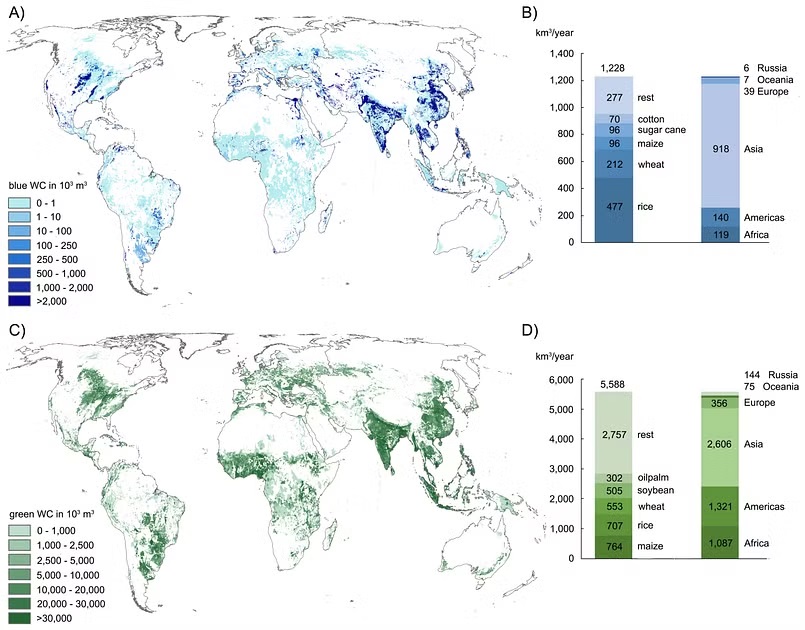
Total annual crop blue and green water consumption (WC) for 2020: a) spatial distribution of blue WC in 103 m3 (map includes paddy WC); b) blue WC for main crops and per continent in m3; c) spatial distribution of green WC in 103 m3; d) green WC for main crops and per continent in m3. Graphic: Davy Vanham/IWMI
The crops with the largest green water consumption, meanwhile, include maize, rice, wheat, soybean and oil palm, with Asia accounting for the largest green water consumption at 2,606 km3, followed by the Americas and Africa.
The researchers also calculated the global blue and green water consumption for the years 2000 and 2010, based on SPAM datasets from those years, to evaluate the change in crop water consumption up to 2020.
The new model and its resulting global crop water consumption database are valuable for informed decision-making in the water and agricultural sectors, particularly in the Global South.