


- Home
- Companies
- RSK ADAS Ltd
- News
- The Phosphorus Challenge
The Phosphorus Challenge
Phosphorus (P) is a crop nutrient found in soils – critical for plant root formation, energy transfer, and DNA synthesis. Despite UK agricultural soils typically having good levels of P, it is an elusive nutrient for plants to capture, with many arable crops failing to take up enough P to reach their yield potential.
The consequences of poor P capture extend beyond harvest. Excess P left behind by a crop can find its way into water catchments, feeding algae and contributing to the eutrophication and suffocation of lakes and rivers.
Why do crops struggle to capture such an abundant soil nutrient?

Industry best practice – Nutrient Management Guide RB209 – advises arable farmers to target a soil P index of 2 (around 20 mg of P per litre of soil). This is a sufficient amount of P to fully support a crop’s growth (total phosphate uptake of 70 kg P2O5/ha), and most farmers will plan their annual P fertiliser applications around this recommendation.
Yet post-harvest grain analysis undertaken within the Yield Enhancement Network shows that over 60% of the cereal crops analysed were below the critical threshold for P concentration (0.32%), indicating this deficiency likely resulted in a yield loss for the farmer.
These results, presented below, indicate the problem is not insufficient P in the soil, but rather that only a small proportion of P is available to the plant.
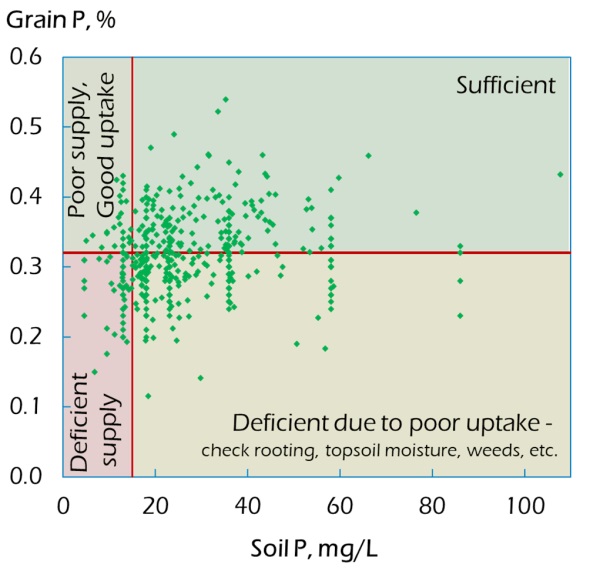
The nature of P is that it is an immobile nutrient – it binds itself tightly to soil particles, making it less available to plant roots.
Soil microbial activity can help convert unavailable forms of P and enable crop uptake. Mycorrhizal associations with plant roots can also increase the effective root surface area, helping crops reach available P.
Sufficient moisture in the topsoil, particularly during late spring/early summer when crop growth speeds up, can also aid nutrient absorption.
Organic materials are a valuable source of P, but low crop uptake efficiency can cause a P imbalance. To ensure P doesn’t limit the crop, farmers often apply more P than the crop requires. This can lead to build-up of ‘legacy’ P in the soil.
If large amounts of P are continually applied to the same field without accounting for crop offtake, excess P left in the soil can slowly, via erosion, find its way into river catchments.

Using phosphorus more efficiently will not only help protect waterways from pollution – it will also boost crop yields and lower input costs for farmers.
There are three potential opportunities to achieve this:
1. Reducing the crops’ demand for P
A crop transfers up to 80% of the P it captures to its seed to ensure its survival, known as phytate. High levels of seed phytate reduces the content of other nutrients such as zinc.
If the crop used P for photosynthesis rather than storing it away, not only will the plant produce more biomass, but it will also result in a more nutritious final food product.
There has already been promising research in the area of low-phytate seed. In 2004, scientists identified a single gene in barley that reduces the concentration of P in seed by 13-15%. Finding ways to reduce this further (by 25%) could lower inorganic P fertiliser requirements of cereals by 10%.
Further research is required to understand the role of plant genes in improving the utilisation of P and what knock-on effect this would have on seedling development.
2. Targeting P fertiliser applications
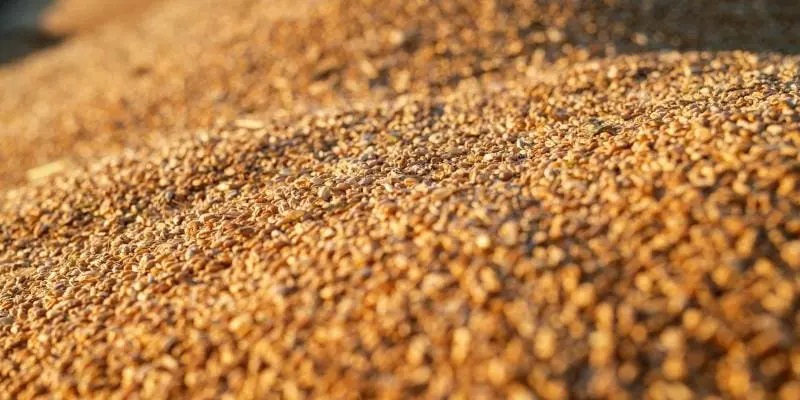
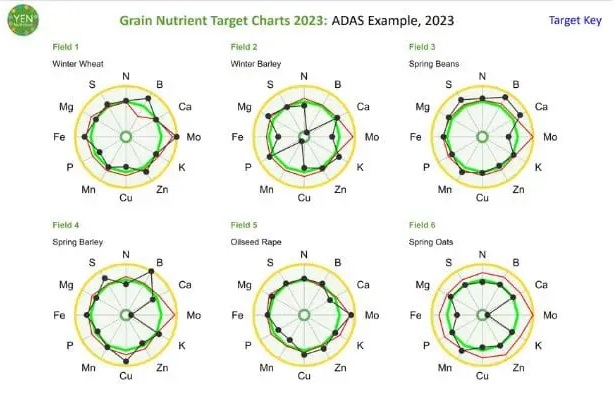
Farmers taking a bespoke, targeted approach to P application with a focus on feeding the crop, not the soil, can reduce the quantity of P applied. By analysing grain post-harvest, farmers can accurately measure nutrient offtakes and determine what remains in the soil before deciding on further applications
Seed fertiliser treatments and foliar fertiliser products are a promising element of a crop P nutrition strategy. More research is required to understand how they can improve crop P uptake efficiency.
3. Utilise P already present in the soil
To access any available P, crops require an extensive root structure – the higher the density of roots and the greater their surface area, the more P they can potentially access. The development of crop varieties with vigorous root systems with high numbers of root hairs should be an ongoing priority.
Soil conditioners, which do not contain any phosphorus, may improve the availability of P in the soil. However, the capacity of these products to improve crop P uptake has not been independently trialled to a great extent just yet.
Some crops can act as useful P ‘scavengers’, with their residues increasing the amount of P available to the following crop. Buckwheat as a cover crop has been shown to increase grain phosphorus levels in the following spring barley crop, compared to bare fallow and other cover crop species. Similar benefits have also been observed with white lupins and chickpeas.

And it’s not only plants that can act as P scavengers – plant mycorrhizal associations and their mycorrhizal hyphae greatly expand the soil volume crop roots can reach. Minimising tillage and ensuring mycorrhizal host plant species are maintained within the rotation will help encourage their activity.
If soil testing reveals that P levels are sufficient or excessive, efforts should shift towards utilising any available P, thereby minimising environmental risks and maximising nutrient recycling.
To support good crop rooting systems, farmers not only need access to superior rooting varieties, but they also require a healthy soil structure with plenty of organic matter to encourage biological activity. Soil conditioners and P scavenger crop species may have a role to play in making P more readily available.
To support farmers in applying these solutions, more independent on-farm experimentation will help uncover ways of managing soil P reserves, as well as supporting the breeding of new crop varieties that can lower crop P demand and therefore allow for better P circularity.