


- Home
- Companies
- RSK ADAS Ltd
- News
- Yield Enhancement Networks for Cereal ...
Yield Enhancement Networks for Cereal and Oilseed end on a high with a new OSR world record
“The fact that three British OSR growers surpassed 7.5 t/ha during one of the driest growing seasons on record is a testament to their skill in exploiting weather extremes”, said ADAS Head of Crop Physiology Dr Pete Berry, adding that a warm Autumn in 2024 had set many OSR crops off to the ideal start:
“October 2024 was warmer than average for almost all of the UK. This was followed by a winter without excessive rain and a very sunny March and April. Looking at weather data and yields dating back to 1976, this seasonal pattern has been conducive to higher-yielding years for OSR, but growers need to be ready to exploit them.”
The same cannot be said for cereal crops, with warmer conditions in 2025 shortening all growth phases. Drought stress at flowering reduced the number of grains set, and Pete estimates that for every 1-degree increase in temperature, the grain-filling phase shortens by 2 days.
“With the wheat crops submitted into YEN every year, we have seen the average grain fill period decrease by several days since 2013 as a result of warmer conditions, often compounded by factors such as a lack of water, insufficient nutrients, and incomplete disease control. More frequent, prolonged wet and dry periods, together with the warming climate, have made for highly variable grain yields in recent years.”
Pulse yields in 2025 were down on average due to the drought, but some farms still achieved incredible yields of 6.7 t/ha for peas and over 8t/ha for beans. Charlotte White, Senior Consultant at ADAS, was keen to commend those pulse growers who have achieved stable high yields over a run of years.
“Stability of pulse yields is one of the most sought-after performance metrics for farmers,” explained Charlotte. “The Pea and Bean YENs have demonstrated that high pea and bean yields are achievable, and YEN data has highlighted aspects which are worth exploring, such as nutrient applications or varying flowering dates to manage the risk of heat stress.”
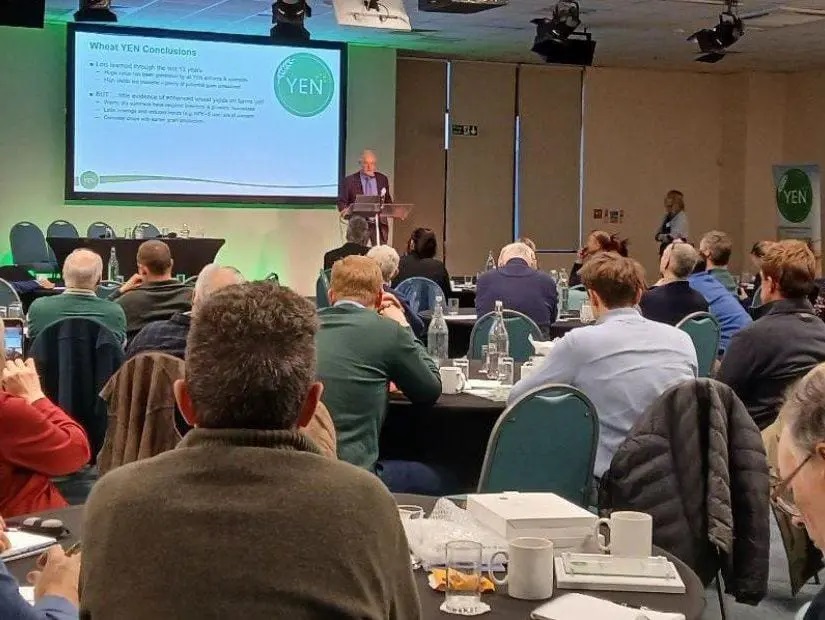
This YEN Conference marks the final chapter for the Cereal and Oilseed YENs, which for the past 13 years has helped thousands of growers in the UK and North-West Europe to benchmark their crop performance and identify their yield potential.
YEN founder Prof. Roger Sylvester-Bradley, reflected:
“The YEN has proved hugely successful – by highlighting, creating and equipping a community of enthused growers and their supporters, by deducing the most successful growing conditions and the most telling metrics for each crop, and by crystallising the vital challenges that farmers, technologists and scientists must still resolve to close those big yield gaps.”
“Considering the UK Government’s mission to ‘spare land’ whilst still securing food supplies, we need to encourage, rather than deter, all these yield enhancement enthusiasts, to better understand the factors they can control and to minimise the impact of factors they cannot.”
Although this was the last year of Cereal and Oilseed YEN, Pea and Bean YENs – in collaboration with PGRO – will continue as normal for harvest 2026, with PGRO taking on leadership in 2027 and beyond.
Pulse growers interested in learning about maximising their crop’s potential can enter Pea or Bean YENs by contacting yen@adas.co.uk.
The principal aims of the YEN are to identify and support arable innovators to drive understanding of crop performance and inspire initiatives across the industry. Through its multiple sponsors, the YEN has increasingly provided a platform for effective communication and synergy between farms, industry and academia.
Since it was first founded in the UK, it has expanded internationally with YENs now in Canada, the US, and New Zealand.
A special thank you to the YEN sponsors in 2025: Askew & Barrett, BASF, Bayer, Dalton Seeds, Met Office, Lancrop Laboratories, NPZ UK, NFU, NIAB TAG, Rothamsted Research, The James Hutton Institute, The Andersons Centre, PGRO, Premium Crops, Senova, University of Lancaster, and University of Lincoln.