

- Home
- Companies
- Acclima, Inc.
- Products
- Acclima - Model True TDR-315H - Soil ...
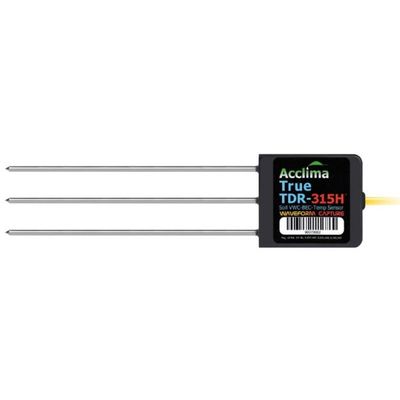
Acclima - Model True TDR-315H -Soil Water Temperature BEC Sensor
A probe guide is provided to insure that the waveguide rods are parallel when pushing them into the soil. Its main improvements over the 315L are its faster rise time, its shaped incident wave, its lower power consumption and its very fast response time. Its rise time is as fast as the TDR-315 but its power consumption is much lower than the TDR-315 and its price is also lower. Its interface is SDI-12 and is compatible with any data recorder that is compliant with SDI-12 version 1.4.
A fully integrated digital TDR, the 315H consumes a fraction of the energy than that of its predecessor, but still maintains a 150 pico-second rise time for superb accuracy.
- Ultra-low power consumption and fast response time
- Designed for easy use in shallower horizontal applications
- Very large sampling volume with the wide spacing and the longer 15cm waveguides
- High accuracy Acclima sensor configuration
- Soil Smart analysis works with all mineral soil types
- Incident Wave Amplitude: 400mV
- 20% to 80% Incident Wave Rise Time: 150 ps
- Waveform Digitizing Resolution: 5 ps
- SDI-12 Interface
- 3-element 15 cm stainless steel waveguide
- 5m or 10m 3-conductor waterproof cable (standard)
- Waterproof Epoxy-filled Housing
- Volumetric Water Content: 0% to 100%
- Medium Permittivity: 1 to 85
- Medium Bulk Electrical Conductivity: 0 to 2000 μS/cm
- Medium Temperature: -40 to +60 degrees C
- Pore Water EC (Hilhorst Model): 0 to 55000 μS/cm
A major advantage of the TDR-315H over its predecessor TDR-315L is that its battery life has been increased 10 fold. This is due to lower current consumption and a faster read time.
- Read Time (from issuance of read command until the return of data): 0.25 seconds
- Operating Voltage Range: 3.5 to 15 volts dc
- Idle Current Consumption: < 10 µA
- Idle Daily Energy Consumption @ 3.5 v: 2 J/day

Permittivity Reporting:
Permittivity is calculated directly from waveform propagation time and does not incorporate any voltage or current parameters. Hence the permittivity calculation is independent of soil electrical conductivity. This is the main advantage of true Time Domain Sensors over other types of sensors.
- Reading Range: 1 to 80 relative permittivity units
- Reporting Resolution: 0.1 relative permittivity units
- Repeatability (RMS deviation): 0.07 permittivity units
Reporting Accuracy:
- Coarse and medium textured soils: ±1 relative permittivity units
- Fine textured soils: ±2 relative permittivity units
Stability of permittivity readings vs Bulk EC: < 1 relative permittivity unit 0 to 2000 µS/cm BEC
Volumetric Water Content Reporting:
VWC is calculated from permittivity using the Topp equation. Hence the accuracy of VWC reporting is that of the permittivity reporting and those further small errors imposed by the Topp equation. Note that the Topp equation is effective only to about 50% VWC. Acclima has replaced that segment of the equation with a linear function of propagation time beyond 50% VWC.
- Reading Range: 0 to 100% VWC
- Reporting Resolution: 0.1% VWC
- Repeatability (RMS deviation): 0.07%
Reporting Accuracy:
- Coarse and medium textured soils: ±1 percentage point
- Fine textured soils: ±2.5 percentage points
- Stability of VWC readings vs Bulk EC: < 1 percentage point 0 to 2000 µS/cm BEC
Bulk Electrical Conductivity Reporting:
Bulk Electrical Conductivity of the soil is calculated from soil resistance measurements between the waveguide elements. Chromium oxide deposits on the waveguide elements becomes significant at high EC levels and the error correspondingly degrades in accuracy at those levels.
- Reading Range: 0 to 5000 µS/cm (Ɵ, ɛ repeatability degrades above 2000 µS/cm BEC)
- Reporting Resolution: 1 µS/cm
- Repeatability (RMS deviation): 3 µS/cm
Reporting Accuracy:
- 0 to 1000 µS/cm 25 µS/cm
- 1000 to 2000 µS/cm ±2.5%
- 2000 to 5000 µS/cm ±5%
Temperature Reporting:
Soil Temperature is measured with a highly precise thermistor that is located about 2mm from one of the outer waveguide electrodes.
- Reading Range: -40C to +60C
- Reporting Resolution: 0.1 degree C
- Repeatability (RMS deviation): 0.01 % C
- Reporting Accuracy: ±0.25 degrees C
Pore Water EC Reporting:
This reading is calculated from permittivity and bulk EC using the Hilhorst model with an assumed soil type. Hence it is of limited accuracy and should be used only as a ball-park reading.
