

Aikan - Compost Plant
In-vessel composting with negative pressure is fully integrated in an Aikan plant. The compost sanitizes in fully enclosed process modules as a temperature of at least 70 degrees Celcius (158 F) for more than 1 hour is obtained the entire mass. The exhaust air is treated in biofilters, which are also fully integrated in the facility. The compost process is an excellent way to stabilize organic matter, break down micropollutants and it is also an energy effective way to sanitize the compost for pathogens. The Aikan batch process, in process modules and in active ventilated maturation bays for storage, makes it possible to produce different types of compost from different raw materials and maintain full traceability. The compost from bio-waste and green waste is high quality fertilizer and soil improvement media. The compost is used in agriculture or as a part of growing media for various purposes.
Compost quality
Compost delivered from an Aikan plant has a precisely defined quality and can be used as a substitute for conventional NPK fertilizer.
- 1 tonne of compost contains the following nutrients (example specification):
- Nitrogen – total: 16.5 kg
- Ammonium-nitrogen: 1.3 kg
- Nitrate-nitrogen: 0.2 kg
- Phosphorous – total: 7.7 kg
- Potassium – total: 5.3 kg
- Magnesium – total: 1.7 kg
- Sulfur – total: 2.7 kg
- Lv, conductivity value (10mS/cm): 11.4
- Lt, conductivity number (10mS/cm): 24.3
- pH-value, acidity: 7.4
- Rt, reactivity number: 7.6
For further details, please see example of a compost declaration from an Aikan plant in Denmark.
Optimale massbalance
The mass balance is the basis of all business in waste management. The big question is always: How can waste be turned into valuable goods with as little residual waste as possible left for costly treatment or even disposal?
At Aikan we focus on quality products and little use of water and/or other virgin resources since we know that all matter put into a system has to come out somewhere.
Even though quality always depends on the good input we are robust in handling wastes of different quality without dilution.
A mass balance from the Danish plant BioVækst based on 10 years of experience can be seen.
It is wise to remember that all matter – also waste – consist of water and dry matter. In organic matter, a portion of the dry matter is organic, dry matter. That means it is based on carbon. Plastic is, though organic, normally not biodegradable. Therefor a mass balance is also about knowing your inputs. At Aikan we know!
Due to its unique design, Aikan Technology allows for batch processing of waste, producing both biogas and compost, without moving the solid waste fraction. An Aikan plant is one of the most effective and flexible solutions available for integration with mechanical biological treatment (MBT). It is a hybrid solution which brings anaerobic digestion and in-vessel composting into a single highly flexible production work flow.
An Aikan system is laid out in such a way that it physically separates hydrolysis (“leaching out”) and methane generation, the two main processes that constitute what is generally known as dry anaerobic digestion.
The performance of an Aikan system relies on the following 3 steps:
Hydrolysis: Inside the process module fresh waste is sprayed with degasified percolate drawn from the biogas reactor. This induces bacterial hydrolysis, leaching out fatty acids. Percolate is drained from the bottom of the process module, effectively separating the waste into dry and wet fractions.
Methane production: The wet fraction (the percolate), with its content of fatty acids, is pumped back to the biogas reactor where methane production takes place, physically separated from the solid waste fraction. Steps 1 and 2 are continued as long as the percolate has potential for methane production.
Composting: When the potential for methane production has decreased, the process module switches to forced ventilation (negative aeration) of the remaining solid waste. Aeration rapidly initiates a highly effective composting process. Heat from the composting ensures complete sanitization and evaporation of excess humidity.
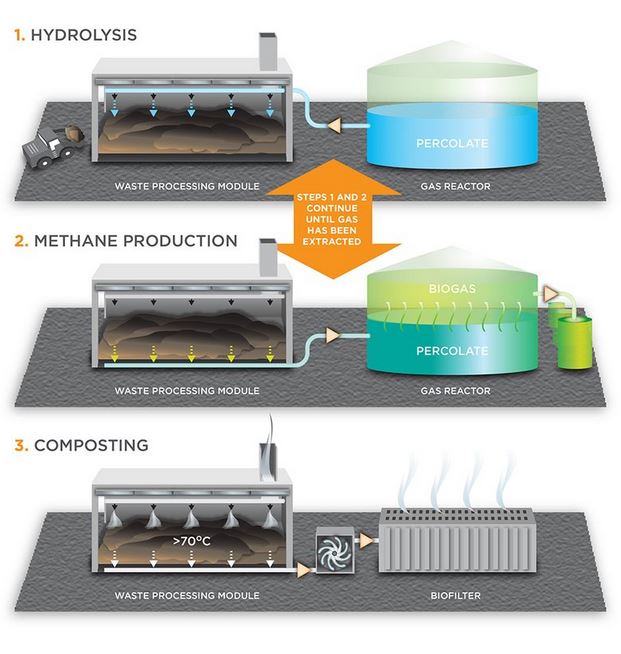
During all 3 steps, the process module remains closed. No solid waste is moved, with only fluids and air circulating between the process module and the gas reactor in a closed system. The system design ensures that the processes of hydrolysis, percolation, methane generation and composting are separate and occur rapidly and extremely efficiently. There is no need for inoculation using earlier processed material to start fresh batches. This insures full traceability.
Aikan Technology optimizes transformation processes that occur naturally in the decomposition of biological waste and makes sure that the outputs can be captured, upgraded and turned into valuable resources that can be recycled. The unique design of the Aikan process allows for the use of reliable and readily available standard technology.
The term “Dry AD” can be a little confusing as the process as such is not dry. “Dry AD” means that the solid waste is handled in solid form whereas “Wet AD” means that the waste is made into a pulp which are pumped around.