


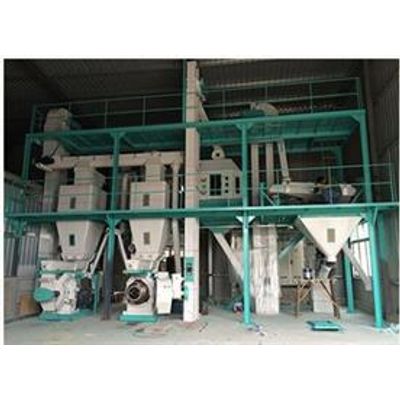
Amisy - Cattle Feed Pellet Plant
Cattle feed pellet is a type of compound feed mainly made from barley, forage, bean, bran, wheat, corn and additives, such as, vitamins, minerals, and other essential micro-ingredients. Pelleting allows the use of a wider variety of ingredients without obvious changes in the physical properties of the diet. It is simply put the feed in a concentrated form. The pellets are very nutritional and can satisfy the growth needs of cattle in different growth stages. By combining moisture, heat and pressure on feed ingredients, a degree of gela-tinization is produced, which allows cattle to better utilize the nutrients in these ingredients. The feed pellets are widely used in small-sized farms and large-medium feed factories.
Cattle Feed Pellet Production Flow Chart
Raw Material Receiving
The raw materials for cattle feed pellets can be corn, barley, wheat, soybean, cotton stalk, corn fiber, grass, maize straw, soybean meal, cereals, molasses, and so on.
Grinding
The grinding process is provided at the pellet plant to grind the materials into powder form. Grinding is the most effective processing technique to improve nutrient utilization and animal performance. Uniform particle size ensures better quality of final pellets. The grinding increases surface area of ingredients for improved rate of digestion and decreased segregation.
Batching
Batching is considered to be one of the most critical and essential operations in feed pellets manufacturing. Proper batching can improve diet uniformity and animal performance. Batching the powder feed raw materials according to the formula.
Mixing
This process is used for mixing the crushed raw* materials with higher uniformity`. The mixing process determines, to a high degree, the capacity of the whole manufacturing process and the quality of the final product
Pelletizing
The main purpose of this operation is to convert mash feed into pellet form by mixing with steam. The mash feed is fed from the storage bin to the feeder, and thereafter to the conditioner, where dry saturated steam is mixed with the feed, and then fed to the pellet mill at a controlled rate. After pelletizing, the palatability and digestibility of feed is largely improved.
Cooling
The newly pressed pellets are very high in temperature. The)` must be cooled to avoid formation of lumps and deterioration of feed quality. The feed pellets are cooled in the pellet cooler by induced cool air draft This process is to cool the pellets to ±3-5°C of the room temperature.
Screening
Cooled pellets are carried to the pellet sieve by an elevator. In the pellet sieve, crumbled pellets and powder materials are separated from the good pellets and sent to the pellet mill for re-pelletizing while good pellets are stored into the bagging bin.
Packaging
This process is to pack the feed pellets into bags which are convenient for storage and transportation. The bagging operation is semi-automatic. The bags are fixed manually and the filling is done automatically.
Benefits of Feed Pellets for Cattle Farming
- Decreased feed wastage during the eating process.
- Improved palatability and digestibility.
- Decreased ingredient segregation.
- Reduced opportunities for selective feeding
- Easy to ship, store and handle.
- A better flow and handling characteristic, particularly important to dairy farmers.