


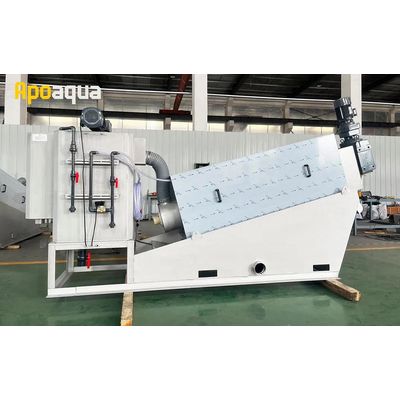
Apoaqua - Model ApoHyr-YZC -Sludge Manure Sludge Dewater for Aquaculture Farms
The sewage from the farms also seriously pollutes the environment. The sewage and feces have typical “three highs” characteristics, namely high concentration of organic matter, high ammonia nitrogen and high suspended solids. It also contains a large amount of bacteria, ammonia nitrogen, and organic phosphorus. Direct discharge of sewage containing pollutants into the natural environment will cause damage to the ecological environment. Before being discharged, sewage needs to be centrally treated and purified to meet the discharge standards before it can be discharged into the natural environment.
Traditional Manure Sludge Dewater System Structure
- It includes pre-separation mechanism, coarse sedimentation mechanism, fine sedimentation mechanism and liquid organic matter removal mechanism.
- The pre-separation mechanism includes a collection tank and a solid-liquid separator. There is a solid material receiving tank at the mud outlet of the solid-liquid separator.
- The coarse sedimentation tank mechanism includes a sedimentation tank and a manure dewatering screw press.
- The aggregate tank is connected to the sedimentation tank. The fine sedimentation mechanism includes the coagulation sedimentation tank and the sludge thickening tank.
- The manure dewatering screw press is connected to the sedimentation tank. The feed port of the manure screw press is connected to the mud outlet of the sedimentation tank.
- Sludge dehydrating agent is added in Manure screw press. The sludge thickening tank is connected to the feed port of manure dewatering screw press. The liquid organic matter removal mechanism includes UASB anaerobic reactor and SBR tank.
- Through the above arrangement, sewage and manure are completely separated into solids and liquids. It effectively reduces the impurities in the liquid and increases the amount of solid fertilizer. It effectively speeds up the treatment of sewage and feces and protects the ecological environment. However, there are still defects in practical application.
Related defects
Manure dewatering screw press needs to add polyvinylamine (PAM) cationic polymer during the treatment of farm manure sludge. The cationic polymer dissolution process requires a large amount of water. Usually the dissolution concentration of PAM cationic polymer is 1%-3%, and the dissolution agent used is tap water from the farm.
When ensuring the amount of cationic polymer used, about 0.3-0.5 tons of tap water are needed for every ton of fecal sludge in the sludge thickening tank. In this process, about 1.5-2 times the amount of filtrate is produced.
Take the wastewater treatment system of a farm with a daily raw water treatment capacity of 60 tons as an example. The manure dewatering screw press produces about 10 tons of filtrate water every day. This greatly increases the amount of wastewater to be treated and the investment and operating costs of the farm.
Improvement Plan for Manual Dewatering Screw Press
In order to overcome the defects in the above technologies, we provide a sludge dewatering system. The upper floating sludge and the bottom sediment sludge in the filtrate water treated by manure dewatering screw press are removed. The filtrate water in the middle layer is then recovered and used for PAMcationic polymer dosing, thereby achieving a recycling result.
Structure
- It includes water storage tank, liquid medicine mixing device, manure dewatering screw press, filtrate skimming device.
- The liquid medicine mixing device is equipped with a water inlet, a medicine delivery port, a liquid outlet and a water inlet.
- The main structure of the filtrate skimming device is a square tank body, including a set of chain structure scrapers, filtrate water outlet, sludge discharge pipe, and sludge collection tank.
- The filtrate skimming device is provided with a scraper to remove the floating sludge on the upper layer of the filtrate.
- The mud hopper is located at the bottom of the filtrate skimmer and is connected to the sludge collection tank through the sludge discharge pipe.
- The sludge collection tank is located below the liquid surface and is isolated from other parts by partitions.
- The feed inlet of the manure dewatering screw press is connected to the water storage tank through a pipe. The outlet is connected to the filtrate skimming device through a pipe. The drug inlet is connected to the drug liquid mixing device through a pipe.
- The water inlet is connected with a pipe to set up the filtrate skimmer.
- The drug delivery port of the drug mixing device corresponds to a polypropylene vinylamine addition pipe. The water inlet corresponds to a tap water addition pipe.
- The scraper of the filtrate skimming device uses a chain structure and reciprocates.
- The filtrate water outlet is located below the liquid surface and is connected to the water inlet of the liquid mixing device by a pipe.
- The sludge collection tank in the filtrate skimming device is subjected to filter pressing treatment. The treated filtrate water is recycled and used as dosing water.
Beneficial Effects
- Save the amount of poly(acrylic acid)amine (PAM) cationic polymer. Using filtrate water for PAM cationic polymer can reduce the dosage of the reagent by about one quarter, thereby reducing the cost of the reagent.
- Use filtrate water to reduce tap water consumption. Taking a treatment system with a daily treatment capacity of 60 tons of aquaculture wastewater as an example, it can reduce tap water consumption by 58 tons per day.
- Increase the treatment capacity of the aquaculture wastewater treatment system. After the use of tap water is reduced, the amount of aquaculture wastewater that can be treated by the system is increased in disguise.
- The filtrate water is recycled to avoid the impact of poly(acrylic acid amine) (PAM) cationic polymer on subsequent systems.