

- Home
- Companies
- US Composting Council
- Products
- Compostable Products
Compostable Products
Compostable (adj): capable of undergoing aerobic biological decomposition in a compost system, such that the material becomes visually indistinguishable and breaks down into carbon dioxide, water, inorganic compounds, and biomass.
Compostable Product (n): Any product specifically manufactured to break down in a compost system at the end of its useful life. May be made from plastic, paper, or plant fibers, along with other ingredients that provide necessary form and functionality. The USCC supports the use of compostable products to the extent that they assist in the efficient collection of food and other organics that can be composted, and, by replacing conventional plastics, reduce physical contamination in finished compost products.
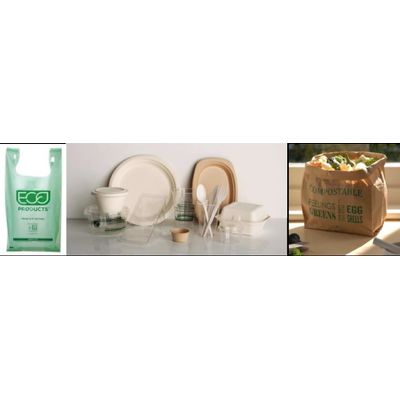
Compostable products include items such as bags, take-out containers, coffee pods, food packaging, cups, plates and serviceware.
All compostable products should be certified as conforming to ASTM or other international standards in order to prevent greenwashing, and to ensure that the products do not create problems for composters or the environment. Meeting the ASTM standards (D6400 or D6868) requires individual ingredients to be tested for biodegradability (consumed by microorganism), and the finished product to disintegrate (physically break down during composting), as well as be tested for plant toxicity and heavy metals. Certification in the U.S. is provided by BPI, The Biodegradable Products Institute.
LABELING IS KEY
To help prevent greenwashing and help compostable product providers clearly identify their products, the USCC, under the guidance of a Compostable Products Task Force, has produced several key resources.
- Labeling Guidelines for Compostable Plastics
- Compostable Food Serviceware Quick Guide
- Model Compostable Labeling Legislation
FIELD TESTING IS AN OPTION
Composters may want to field test already-certified products, to be sure the product will disintegrate in their specific system. To help make these tests more consistent, and collect data on how varying conditions impact disintegration, the Compost Research and Education Foundation (CREF) launched an open-source field testing protocol. With the success of the Cedar Grove Compost testing program, the Compost Manufacturing Alliance is also working on field testing and approvals using varying composting technology.