


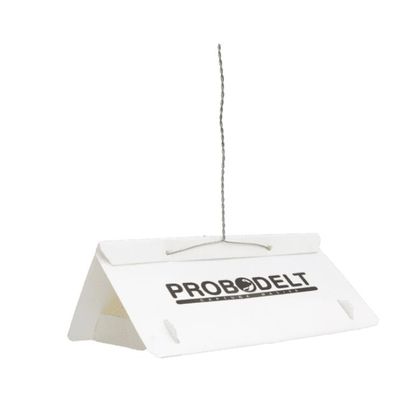
Delta - Model TD -Trap
The Delta trap is a versatile trap suitable for flight tracking (monitoring). Some of the pests we can follow with the appropriate pheromone are: Prays oleae, Prays citri, Lobesia botrana, Cydia pommonella, Anarsia liniatella, Annoying Grapholita, Plodia interpunctella, etc.
What is it?
It is a trap designed for the capture of different flying insects, especially moths.
It consists of:
- The body of the trap that prevents the entry of the water and serves as a support to place the Delta base. In its section it has the shape of a triangle, hence its name (Delta). They can be of various colors, the most used being the white ones.
- The clamping system that goes hand in hand with the body of the trap and consists of a metal hook to facilitate its placement in the branches.
In order to use this trap you must buy separately the Delta Base or also called a gummed base or background (stick surface). It is placed inside the trap and that is where the catches are attached.
What`s the use?
The Delta trap is a versatile trap suitable for flight tracking (monitoring). Some of the pests we can follow with the appropriate pheromone are: Prays oleae, Prays citri, Lobesia botrana, Cydia pommonella, Anarsia liniatella, Annoying Grapholita, Plodia interpunctella, etc.
How to apply it?
We will hang the Delta trap using the metal hook on a branch of at least 1 finger thickness (about 2-3cm) or on a support of the cultivation structure, with the side openings oriented to the direction of the predominant wind in the area and preventing the Delta trap from being completely exposed to the sun but at the same time not being excessively hidden.
It is important to change the Delta base when the gummed (adhesive) surface is saturated by dust, various waste, the same pest, or simply lose its functionality.
Within the Delta trap, attached to the Delta base, the specific pest pheromone is incorporated to follow that usually lasts 5-6 weeks (45 days).
When to apply it?
The moment of the Delta trap will be determined by the nature of the plague and cultivation. You can consult the biological cycle of pests to determine the most appropriate moments of application.
For example, in the case of Anarsia liniatella we will place the Delta trap in early May, while in the case of Palpita unionalis we will place it in early March.
How many Delta traps to place?
To track the population we will place between 2 and 5 Delta traps per hectare depending on the plague to follow.
How`s it sold?
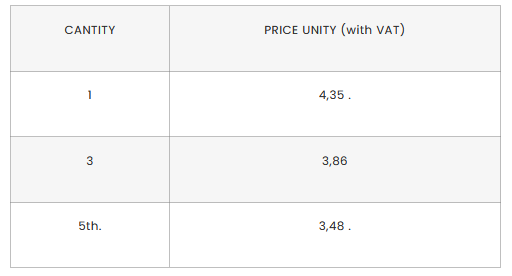
It is sold in a unitary way.
The Delta Base to be used along with the Delta Trap is NOT included with the purchase of the Delta Trap.
The pheromone that has to be used is NOT included with the purchase of the Delta Trap.
When to remove it?
Depending on the nature of the plague, generations of it...we will retreat the Delta trap after its use for reuse in the future or we will keep it throughout the cycle.
You can consult the biological pest cycle to determine the right time to remove the trap (if the inactivity period is short we can keep it uninterrupted in the field).
For example, in the case of Anarsia liniatella we will remove it at the end of October, while in the case of Palpita unionalis we will remove it in the end of August.
Any doubts?
If you have any questions about the product and/or your application you can contact us via phone/WhatsApp or via email.