


- Home
- Companies
- Global Odor Control Technologies (GOC)
- Products
- GOC - Vapor Phase Generators
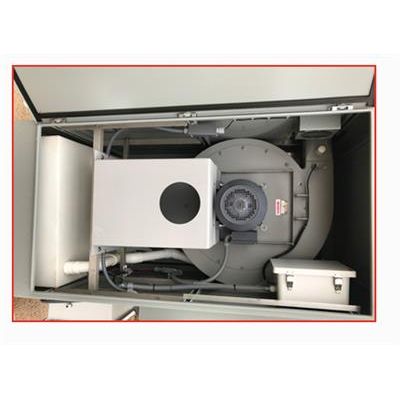
GOC - Vapor Phase Generators
Vapor Phase Generators available in configurations capable of supporting five hundred to four thousand linear feet. Indoor or outdoor use. Trailer-mounted units also available.
- No water consumption
- No nozzles
- Low Maintenance
- All weather operation
- True deodorization – not masking
- More effective and economical than misting
For years composters have expounded the virtues of oxygen and the need for lots of aeration produced either by blowers in stationary systems or by mechanical agitation - "turning", in windrow systems. However, credible, published studies indicate that turning has little value as an aeration source. In fact, the studies show that oxygen from turning is used up in 4 hours or less, yet the materials don`t stop composting after that oxygen is exhausted. They compost quite happily during the week or two week intervals between those turns. Several studies do show that turning speeds up the process - not because of oxygen, but because every turn is similar to an additional shredding or grinding, effectively downsizing the material. This downsizing looks good, but has the negative impact of making materials appear more finished than they really are - and think of all the fuel that`s burned! Wouldn`t it be great if that same or even greater processing speed could be achieved using biological decomposition almost exclusively?
Consider good aerobic topsoil. It may only get aerated once a year - if at all! Yet it retains its aerobic qualities and supports excellent microbial populations and plant growth. Why is this? One reason is the porosity created by different particle sizes of soil, rocks, and roots. Another is the balance of similarly charged ionic minerals in the soil. When mineral particles have like charges, they repel each other, and the repelling action helps cause porosity. The composter attempts to achieve differing particle sizes by shredding and by using different varieties of materials. QuikSoil®2600 duplicates the mineral balance of aerobic soils, creating aeration in compost through cationic (positively charged) cellular unit relationships among minerals, and anionic (negatively charged) cellular unit relationships among certain vitamins and minerals. Imagine dropping a group of positively charged iron shavings into a bowl of dirt. The shavings would push away from each other, and in the process the dirt would be moved and aerated.
This quality allows composters to greatly reduce external aeration activities. This can mean less electricity to operate aeration pumps or blowers, or less diesel fuel to operate row turners.
In fact, most of our clients only turn materials two to four times during the entire process. As the price of diesel climbs, fuel savings alone can justify the use of QuikSoil 2600.
QuikSoil® 2600 in conjunction with the BACS system (Biologically Accelerated Carbon Stabilization) results in greater levels of maturity when tested by Dewar Flask reheat, CO2 production, and ammonia production. Typically, composting is a sequential process, accomplished by different levels of activity occurring one after another. Imagine a documentary showing a leopard taking down an antelope on the African veldt. The leopard eats its fill, followed by hyenas, then vultures, and so on according to strength and size. The leopard gets its choice of the food, and the remaining groups settle for less and less desirable food - by the leopard`s standards. This is sequential decomposition. During and after all this visible dining, microbial digestion is occurring as well. In many ways the process is similar to its visible counterpart. The hardiest, fastest, and often largest microbes get the best food. To a microbe, "best" means the food which yields the most energy for the least energy expended. When the second wave of microbes develop, their food sources are now composed of the compounds the first group were unable to digest, and the bi-products created during preparation of the compounds they could digest. As decomposition proceeds, more and more population shifts occur in conjunction with growing complexity of available substrates (foods), and growing energy expenditure to yield ratios.
Typically, microbes proliferating in more complex and energy expensive environments have developed the ability to digest wide varieties of substrates. They have developed these broad digestive skills out of necessity as they are unable to compete successfully for more easily digestible resources. If the food choices are chocolate cake or coffee grounds, and you are faster than me. Then I will need to learn to love coffee grounds.
The BACS process enables many of these less capable but highly adaptive bacteria to develop early in the process rather than later. Due to their broad digestive skills, many parts of the decomposition process can be accomplished almost simultaneously, and the sequential processes can be accelerated. QuikSoil® 2600 accomplishes this by adding specific substrates which cannot be digested by most strains, and the necessary enzymes to allow these strains to begin digestion rapidly. In this manner, creatures that would not normally be able to compete successfully early in the process are able to establish colonies and flourish throughout the composting mass.
While the exact process is proprietary, the concept is relatively simple. In nature, once potential food is located, a microbe may need several minutes or hours to build the enzymes required to facilitate digestion. During that time lag, the opportunity to grow and reproduce may be lost or the resources may be secured by faster, hardier strains. Thus, competition determines the population characteristics and thus the decomposition rate of the decomposing mass. QuikSoil® 2600 provides the food and makes it immediately available by supplying the required enzymes and co-enzymes as well. The net result is greater population, and more diverse population, which translates into faster decomposition. In effect, finished compost - stable compost - can be defined as material which has been so fully digested that the remaining compounds are chemically inhospitable (hydrophilic acids) or so complex that more energy is needed to digest them than is yielded in return (humic acids).
Simply by reducing turning or other forms of aeration or agitation, the QuikSoil® BACS system results in less volatilization of carbon as CO2 and VOC`s, and in less volatilization of nitrous and sulfurous compounds. However, 2600 and BACS work in more ways than this. Think of biological decomposition as a continuous search for energy and the resources to grow and reproduce. Just as humans do, microbes need carbon (carbohydrates) for energy, nitrogen (for protein production), and sulfur (for DNA bonds) to create new cells. All the emissions attributed to biological decomposition are composed of compounds essential for microbial life, growth, and reproduction. These compounds escape the decomposing mass only because (1) operator volatilizes them before they can be digested; or (2) the correct microbe capable of digesting the compound was not growing in the mass or not growing in sufficient quantity to encounter the compound before it escaped.
While the goal of digestion is glucose or another energy rich compound for final conversion to energy, bacteria are specialized in their digestive abilities. Turning a carbon compound into energy may require a few reactions or a host of reactions depending on how complex the compound is. Most bacteria are limited in their abilities to digest compounds (substrates). Some can handle a few substrates. Some can handle more, and some can digest an immense number of substrates - as many as 150 ! By encouraging the growth of these broad scale digesters, and by keeping compounds in the mass longer, more and more potential emissions are fully digested. This results in much less odor and in much more carbon and nutrient retention.
Independent tests have shown reductions in all major categories of gases and overall odors of 70% to 80%. Categories tested include reduced sulfur compounds, ammonia and amines, mercaptans and other VOC`s, and ptomaines. Tests have also shown increased organic content in the final, stable compost, and an increase in organic Nitrogen with an accompanying decrease in ammonia and nitrate.
During shredding or grinding of incoming feedstocks, QuikSoil® 2600 mixed with water is added to the materials as they are discharged. Depending on the feedstock, the correct application dose of QuikSoil® 2600 may be 3, or 4 or more ounces per US ton ( 100 to 130 mil per Imperial tonne). Water is added to the QuikSoil® 2600 as a carrier and as a means of creating sufficient liquid to mix the product evenly throughout each ton. The materials are then moved into piles or rows. One week`s material should be used to form a given row or "block". For high volume sites a shorter period may be used, but it is important that - initially - materials separated by more than a week`s time are not mixed together. Ideally, rows or blocks will be placed directly next to each other with the lower portions touching. This creates better insulation from cold and wind and creates more efficient heat storage in the materials. It also facilitates migratory activities from row to row as the process progresses.
Moisture is just as important in QuikSoil® BACS as it is in conventional composting. It is essential that materials be sufficiently moist when the rows/blocks are initially formed. Water may be added if needed at the motion points in the process. Materials should not be over-watered. Materials should be damp but liquid should not run out when pressure is applied.
Once blocks are formed, they must be monitored closely for temperature. If the temperature climbs steadily and maintains consistent thermophyllic levels, the materials do not need assistance. LEAVE THE BLOCK ALONE! (On rare occasions a block may not reach desired temperatures. If this occurs, remix the materials and make certain sufficient moisture is available.) After 5 to 7 weeks, temperatures will begin to recede. At this point the material should be moved (turned) with either a side discharge turner or with front skid loaders. The primary function of this turn is to move external items to the inside of the mass. Water may be added at this point as necessary.
4 to 5 weeks later the temperatures will again recede slightly. At this point the materials are turned again. The major function of this turn is to allow moisture to escape. The material should then be left undisturbed for 2 weeks. After this period the compost is ready to be screened and is acceptable for use or marketing at this point. However, a maturation period of 2 to 3 weeks may be implemented after screening if desired, and is highly recommended for maximum quality. During this 2 to 3 week period creatures called actinomycetes will flourish in the material, initially making the surfaces appear silvery gray. As their activities progress, the materials will begin to smell, feel, and look more and more like good soil. After this brief maturation period the compost will be superior to normal composts in every way, and will have the qualities of much older naturally produced composts. Thus, the entire process takes only 12 to 16 weeks with 2 or 3 turns and a trip to the screener.
This process saves our clients 20% to 55% annually on fuel consumption, and results in finished product with high organic matter content. As a bonus, there is a dramatic reduction in process odor throughout.