

- Home
- Companies
- Darwin Chambers Company
- Products
- Darwin - Insect Rearing Rooms
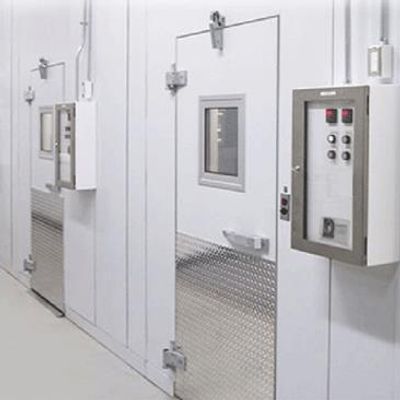
Darwin - Insect Rearing Rooms
Our insect rearing incubators offer reliable, efficient environmental controls for a variety of applications, including: microbiology, life science, drosophila-rearing, mosquito rearing, insect incubation, stock storage, biologic culture incubation and ALAAC, OLAW, USDA, NIH-compliant vivariums.
- Temperature conditioning system can be serviced or relocated quickly, due to a pre-charged and self-contained design.
- Available high temperature decontamination.
- Heat provided to incubators through one of three ways: ambient heat, hot-gas bypass refrigeration, or electric heat.
- Temperature ranges from 5° C to 60° C, 15° C to 37° C, 32° C to 60° C, etc.
- Supplied with LED lights which emit significantly more light per unit of input energy than fluorescent bulbs. They also produce less radiant heat, and with less heat used, the cooling requirement for the controlled environment is diminished and the total energy used by an LED-equipped chamber is substantially reduced.
- ADA compliance available with no additional cost to the customer.
- Conditioning System Features: quick installation, extended reliability, efficient operation, precision control, simple servicing, low GWP, and low total cost of ownership.
-
Personnel emergency alarm: illuminated pull to reset push-button (inside room), control panel mounted visual and audible alarm. Includes glow in the dark label and a glow in the dark antimicrobial pull cord that can trigger alarm when pulled, a life saving feature for injured personnel lying on the floor.
The fans for the transport of recycled materials consist mainly of the following:
- Carcass: It is the external structure of the fan, made of steel. The housing contains the internal parts and provides support and protection to the equipment.
- Rotor: It is the rotating component of the fan, responsible for moving the air. The rotor is made up of blades that create the airflow needed to transport recycled materials.
- Engine: The electric motor is the one that provides the power to spin the rotor and, therefore, generate the airflow.
- Air entrance and outlet: The fan has openings or connections for the air to enter the system and leave it, allowing the transport of recycled materials through the ducts.
The Darwin Advantage
All installed instrumentation is calibrated to NIST traceable standards and provided with a calibration form. In-house, factory calibrations are performed using state-of-the-art equipment with great accuracies. These reports are three-point verifications, traceable calibration documents.