
- Home
- Companies
- Aquabiotech Inc.
- Products
- Aquabiotech - Lobster Purging & ...
Aquabiotech - Lobster Purging & Seasoning Systems
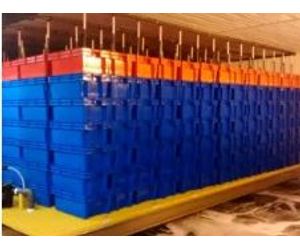
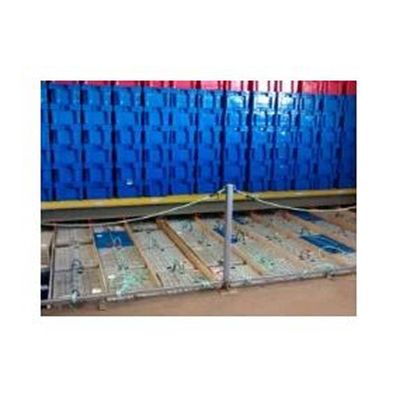
Maximized Footprint; Our Eco Lobster-Condo Purging Systems are built to optimize lobster wellbeing, footprint, and the owner’s budget. They consist of a concrete pond into which standard plastic crates are floated. Inert liners keep crates in a straight line all the way across the pond, making handling easy by pulling the outer crates. The pond is covered by a gridded floor over which plastic fish totes are stacked under a shower.
During the first weeks of fishing, lobsters land in large numbers, and ample storage space is needed. A shower system nearly triples the holding capacity of a lobster pond. Floated crates on one level will hold 20 pounds of lobster per square foot (100 lb/crate), while a shower system (6 crates high) holds 57 lbs/sqft (55 lb/tote)!
This translates into huge savings in land, building, and concrete work. Operators can focus on one pond instead of three. Doesn’t it largely compensate for the additional water and pumping costs associated with the shower system?
With it’s four built-in stand pipes, combined with a series of factory-calibrated holes, these cost-effective fish totes keep lobsters submerged while fully utilizing vertical space. We carefully adjust the water flow over each stack (generally 6 totes) to maintain optimal oxygen level and water quality across the whole stack at all times. Clean, well-oxygenated water flows freely around each lobster, allowing them to revive.
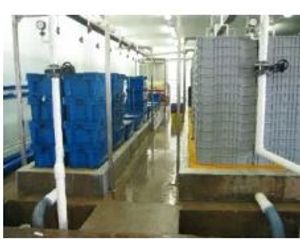
Because of the large product movement through a purging system, ammonia excretion and oxygen consumption vary widely. Most purging systems are therefore located close to shore with access to clean seawater and do not include a biofilter. Instead of a biofilter, we apply a well-balanced flow with fresh seawater make-up to dilute ammonia levels down.
The hydraulics of these systems can be defined as semi-open: while about 90% of the flow across the pond is recycled back to the shower system, 10% of this flow comes from the wharf. This fresh seawater’s primary role is to carry ammonia and organic matter out of the pond through dilution. Otherwise, the pond is self-sufficient in terms of providing the essential oxygen and removing carbon dioxide, water flow and preventing gas supersaturation.