

- Home
- Companies
- Agro-nika d.o.o.
- Products
- Agro-nika - Model Slavol - ...
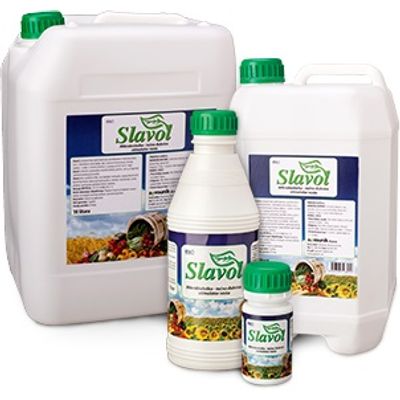
Agro-nika - Model Slavol -Microbiological Fertilizer
Slavol is organic, microbiological fertilizer for foliar supplemental feeding of vegetables and flowers.
SLAVOL is liquid microbiological fertilizer, growth stimulator certified for application in organic and traditional agricultural production. This product contains no chemical additions and effects positively the plants, the soil and the environment.
Slavol is used for foliar supplemental feeding of:
FIELD CROPS:
Small grains (wheat, barley, triticale etc.), corn, soya bean, sunflower, sugar beet, fodder, tobacco.
VEGETABLES (in the field and indoors):
Tomatoes, peppers, cucumbers, cabbage, root vegetables, leafy vegetables, legumes, etc.
FLOWERS (in the field and indoors):
- Roses and seasonal flowers:
Chrysanthemum, Begonia, Petunia, Viola, Salvia, Dalia, Aster, Clubmoss, Lantana, Motherwort, Marigold; - Perennial and ornamental grasses:
Lavender, Sage, Iberis, Echinacea, Hosta, Rosemary, Vinca;
- Evergreen and deciduous trees and shrubs:
Boxwood, Hydrangea, Hibiscus, Berberis; - Coniferous trees and shrubs:
Thuja, Cypress, Juniper, Yew
Slavolcontains bacteria that are isolated from the root surface and multiplied on a suitable nutritive agar. In the process of multiplication as secondary metabolites they produce auxins, which are totally of natural origin, and auxins synthesized by the plant.
SLAVOL CONTAINS
- NITROGEN-FIXERS – bacteria performing the process of nitrogen fixation, i.e. transform the atmospheric nitrogen (contained in the atmosphere in the amount of app. 78%) into accessible forms that directly provide the plants with nitrogen at the root system
- PHOSPHORUS MINERALIZING BACTERIA – bacteria that decompose organic compounds of phosphorus (composing 50-80% of phosphorus in the soil) and transform them into an accessible form (P2O5). These bacteria have the ability of binding to the root system where they directly provide the plants with the accessible phosphorus.
- GROWTH REGULATORS – AUXINS. Auxin activity corresponds to the activity of indole-3-acetic acid (IAA). With the foliar application of Slavol, these substances go through the leaf stoma and get to the other parts of the plant through distribution vessels where they stimulate physiological processes in plants.
THROUGH THE LEAF
By foliar application of Slavol, auxins (IAA) enters the leaf through stomata (openings on the leaf surface and backside), and get into the phloem through the spongy tissue. Through the phloem, auxins get into all parts of a plant, where they act on a large number of physiological processes:
- Promoting plant growth
- Increasing development of adventitious and lateral roots
- Increasing root activity
- Increasing leaf mass and photosynthetic activity
- Pollination and fruit development
THROUGH THE ROOT
With the application of Slavol, bacteria reach the soil and root. They have the ability of colonizing (settling) on the root system, where they positively affect the increase of plants in the following manner:
DIRECTLY
- Plant nutrition with nitrogen (nitrogen fixation, nitrogen mineralization)
- Plant nutrition with phosphorus
- Plant hormones production
- Improved availability of iron and other microelements
INDIRECTLY
- They act inhibitorily on plan disease causers (they synthesize antibiotics, competition for space and food in ecological niches)
- They increase plant resistance to diseases and stress
- Stimulates plant growth
- Increases development of adventitious and lateral roots
- Increases root activity
- Increases leaf mass and photosynthetic activity
- Effects pollination and fruit development
- Better utilization of nitrogen, phosphorus, potassium and microelements
- Increases the microbiological biomass content in soil
- Eliminates the negative impact of pesticides and mineral fertilizers
- Increases plant resistance to disease, low temperatures and drought