


- Home
- Companies
- Omex Agriculture Ltd
- Products
- Omex DIDIN - Nitrification Inhibitor ...
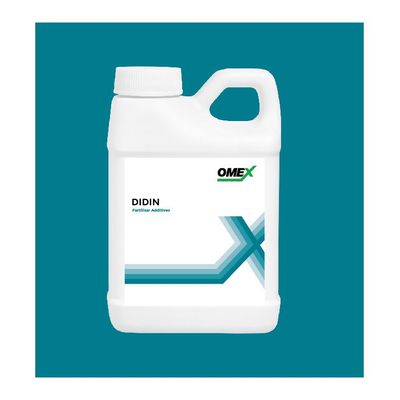
Omex DIDIN - Nitrification Inhibitor for Liquid Fertiliser
DIDIN is a nitrification inhibitor for liquid fertiliser that offers farmers a variety of benefits: Nitrification inhibitor. Reduces carbon footprint. Reduces nitrous oxide emissions. Improves nitrogen use efficiency. Improves yield. Enables all nitrogen to be applied in one pass.
- Sustainable fertiliser use
- Use with liquid fertiliser and organic nitrogen sources
- Helps the nitrogen applied to be steadily available to the crop
- Reduces leaching
DIDIN is a nitrification inhibitor, created with NprotectioN technology, and has been part of the OMEX range for over 30 years. It’s an inorganic liquid formulation containing DCD, designed to improve Nitrogen Use Efficiency, reduce nitrous oxide emissions, allow the full seasons fertiliser application to be applied in a single pass and reduce the carbon footprint of fertiliser applied.
DIDIN works by safely protecting your valuable nitrogen liquid fertiliser application, delivering a steady supply of crop available nitrogen throughout the growing season, leading to higher yielding and higher quality crops. Utilising DIDIN means the crop can utilise more of the nitrogen applied, increasing Nitrogen Use Efficiency.
DIDIN has been expertly formulated to offer farmers a variety of convenience, agronomic and sustainability benefits. It’s been rigorously tested to ensure it consistently delivers on Nitrogen Use Efficiency and is safe to use on soils. You can watch more about the benefits of DIDIN here!
The bacteriostatic action of one of the nitrification inhibitors in DIDIN, dicyandiamide, works selectively on Nitrosomonas europeae controlling the oxidation of ammonium to nitrate. By keeping the nitrogen in the ammonium form which is less prone to leaching, nitrogen losses can be kept to a bare minimum.
Dicyandiamide is broken down as soil temperature increases. DIDIN therefore releases more nitrogen as the crop requires it. When applied with slurry in the winter months, DIDIN can stabilise the nitrogen until the crop can use it in the spring.
DIDIN has the power to reduce the carbon footprint of fertiliser applied. The IPCC refers to a default figure of 1% of the N applied being lost as nitrous oxide (N20) from soil, as a result of denitrification and as part of the nitrification process.
There is recent grassland work, showing losses of 0.6 to 2.08% and referring to an average 1.12%, broadly in agreement with the IPCC default figure. The average of a range of studies with the active ingredient in DIDIN (DCD) demonstrates a 65% reduction in N2O emissions, largely due to a reduction in denitrification losses and probably also due to a reduction in the rate of nitrification.
Arable farmers using DIDIN could be credited with a reduction of around 500 to 700 kg/ha CO2e, according to the amount of nitrogen applied.
DIDIN has been expertly formulated to safely store nitrogen fertiliser within the soil for a steady crop supply. Due to the technology within DIDIN, farmers can apply their full season’s liquid nitrogen fertiliser application in a single pass. The DIDIN will hold the nitrogen crop available for longer.
This offers a number of benefits to farmers. Applying the full seasons fertiliser requirement in one pass reduces soil compaction due to reducing the amount of passes travelled across the soil. With weather patterns changing in the UK it also ensures the full seasons fertiliser application has been safely applied when needed, alleviating the worry of excess rainfall making the crop inaccessible for the second and/or third pass.
Find out how DIDIN helped improve Ed Ward’s farming business amidst unpredictable weather changes!
The Teagasc soil science research team in Ireland, led by Dr Aoife Duff and Dr Patrick Forrestal, have been conducting an ongoing 5-year study on grassland at Wexford, Ireland. Looking specifically at fertiliser inhibitors and soil health, including the use of DCD which is marketed as DIDIN by OMEX.
The published findings concluded:
- “Bacterial and Fungal communities were not significantly affected by inhibitor treatments with long-term usage”
- “Microbial function and the abundance of nitrogen cycling communities were mainly unaffected by fertiliser or inhibitors”
- “The application of Urea or CAN did not change bacterial composition or diversity, but did alter fungal community structure”
- “Overall, we find that the effect of fertilisation on the microbial community is greater than the impact of inhibitor use”
DCD has been shown to be highly effective at reducing nitrate leaching and nitrous oxide emissions and has been shown to have a highly specific effect on nitrifying bacteria, with no effect on the general soil microbial communities.
Using a fertiliser inhibitor, such as DIDIN, is safe to use on soils and does not impact soil health. Both the OMEX internal R&D facility and external agencies have demonstrated fertiliser inhibitors are safe on soils and a useful management tool for reducing emissions and farming sustainably for growers.