

- Home
- Companies
- RPS Solar Pumps
- Products
- RPS - Off-Grid Irrigation Solar Pump
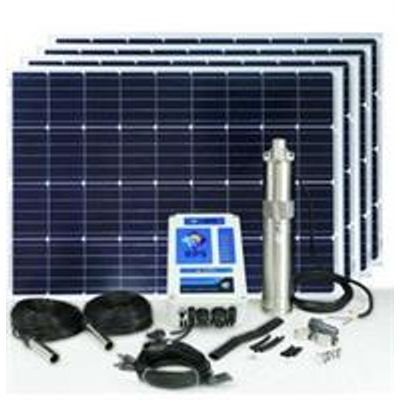
RPS - Off-Grid Irrigation Solar Pump
While our most popular solar pump systems use two small solar panels, we also sell systems like the one shown in this video for larger farms and grows.
Your Yield and Profits depend on Reliable Water
You can’t take any chances with cheap unreliable pumps or siphoning off regulated water sources. Your gas hauling generator days are behind you.
More and more farmers and growers are switching to effortless (and quiet!) solar for their water pumping needs. An simple backup options give you peace of mind your plants will have water when they need it.
- See Increases in yield/production with better regulated drip
- Effortless automatic watering
- Easy calibration of gallons per plant
- Water important as soil and nutes
Off-Grid Irrigation
Creating a pressurized water system for off-grid irrigation
Two of the major factors in designing an irrigation system are pressure (psi) and flow rate (Gallons Per Minute, GPM). When you open the hose bibb to water your lawn, the water is already pressurized and comes out at between 5 and 10 GPM. In towns and cities this is part of the municipal infrastructure, but off-grid we must pressurize our own water systems using elevation or a pump – submersible or surface (traditionally coupled with a pressure/bladder tank in a well-house or basement).
RPS can help with it all. Well Pumps, Transfer Pumps, Pressure Pumps, Dewatering Pumps, Soaker Hoses, Drip Lines, Sprinklers.
RPS Irrigation Customers have saved 4132 miles of power lines and gotten back about 2000 hours of peace and quiet without a loud polluting generator, massively their impact and carbon footprint and created hundreds of satisfying moments of satisfaction at the end of a long productive day off-grid.
When the sun shines on the surface of your solar panels, the movement of electrons generates DC power which is transferred through attached wires to the pump controller.
The pump controller is the brains of the system and with sophisticated technology and sensor inputs, it turns the submersible motor and drives the pump to push water against gravity to the surface.
Solar pumps are sized by calculating the total vertical feet they’ll need to push water, the pressure they need to generate, and the total water required each day.
Start sizing your pump now
Common Irrigation Pressures
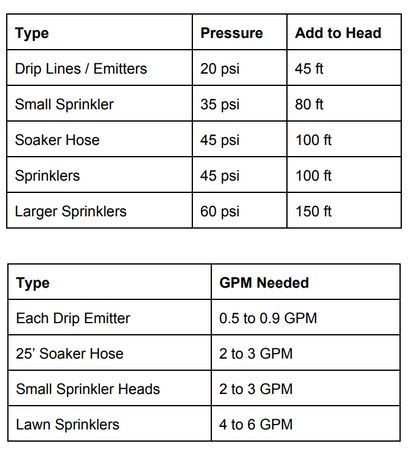
The relationship between pressure in pounds per square inch (psi) and head (in feet) is especially relevant when sizing pumps for irrigation. Each psi is equivalent to 2.31 feet of head. In other words, if you had a water column that was 231 feet tall, you would have 100psi if you opened a valve at the bottom. Common Household pressure is between 35 and 60 psi. As different types of irrigation require lower pressures, Regulators are used to lower this pressure for calibrated water output. The Total Head for a pump is calculated by adding the height the pump needs to push water and the head needed to create pressure. At right are examples for common irrigation types.
Ensuring Proper Water Volume
In addition to the pressure of the water, each different type of irrigation requires certain volumes as well. A large lawn sprinkler needs more water then drip irrigation with a single emitter. When the required flow exceeds the volume supplied, the common practice is to break an irrigation system into multiple Zones so there will still be enough GPM volume for each.
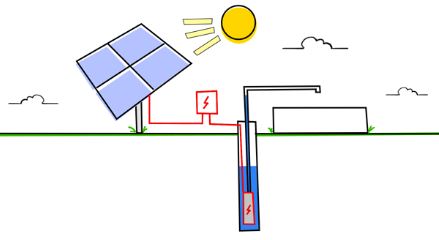
This installation is the simplest way to get 24hr water pressure for irrigation. (if you have elevation on your property) Install plumbing from well pipe to your elevated tank with a check valve on the pump to ensure the water doesn’t siphon back down into well from tank. Each 2.31 ft of elevation the tank has above your plants gives you 1 psi. For drip lines you need at least 20 psi (45 ft tank elevation) and for sprinklers 45 psi (100 ft tank elevation).
Also a popular technique, this installation method involves a battery powered booster pump to pressurize the water from a storage tank. The pump has a built in pressure switch that will turn itself off automatically when valves/timers are closed and back on when valves open. (no need for a pressure tank if pump has built-in pressure switch like the P100) The battery for this booster pump can be charged with a solar panel and charge controller or with a standard AC battery charger.
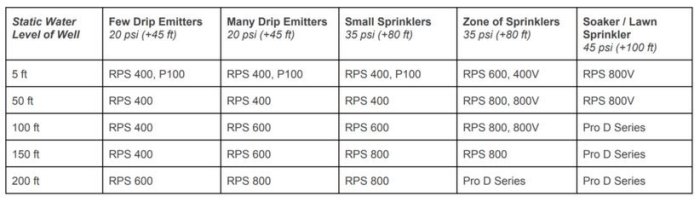
Batteries and a reverse action pressure switch are used to create 24/hr pressure. The pressure switch will wire to the RPS Controller and when the pump fills the pressure tank to the proper psi, it will turn the well pump off. Whenever there is a pressure drop (open valve/timer) the pressure switch will activate the pump to refill the tank and keep the pressure up. The following table shows which RPS Pumps Systems are best suited for Well Pump Pressure. As the head increases (deeper well, higher pressure, steeper hill, etc) generally the volume any pump can generate decreases along its pump curve.
You can install yourself in a single afternoon. No scheduling expensive installers and having them get lost. No strangers walking around your land. Pump while enjoying peace and quiet at the same time.
Peace of mind knowing RPS engineers are ready to pick up the phone if you need us. Industry-Leading Warranties and the the RPS Water Assurance Plan to make sure you have the right pump, parts, and tools for a fast and easy install.