


- Home
- Companies
- Reed Mariculture Inc.
- Products
- Reed Mariculture - Model 1800 - ...
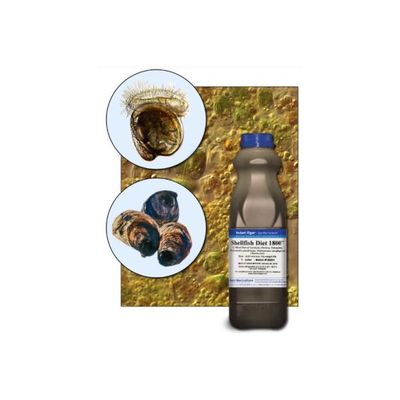
Reed Mariculture - Model 1800 -Shellfish Diet
Shellfish Diet 1800 is a unique mix of five marine microalgae - Isochrysis, Pavlova, Tetraselmis, Thalassiosira weissflogii and Thalassiosira pseudonana - species that have demonstrated success with a wide variety of freshwater and marine shellfish, including: oysters, clams, mussels, scallops, crustaceans, soft coral. This mixed diet provides nutrition all life stages (first feeding larvae through setting, spat, fattening and maturation), providing increased growth and survival rates.
- Shellfish
- Cucumber larvae, ascidians (tunicates), Artemia, and some copepods
- Freshwater mussel research
- Effective for use with open tanks, silos, bottle upwellers, header tanks (with circulation), cultch tanks, and depuration tanks
- For larvae and post-larvae and/or broodstock conditioning, use LPB Frozen Shellfish Diet® with a higher percentage of larger algae cells
Shellfish Diet 1800 offers:
- More DHA providing a healthy balance omega fatty acids, lipids and protein.
- Diatoms for first feeding larvae (small sized Thalassiosira pseudonana)
- a concentrated, clean, liquid form
Shellfish Diet 1800 has been used successfully for:
- Peak-load Supplement – Expand production while reducing live algae demand by feeding larvae Shellfish Diet 1800
- Back-up Feed Supply – Shellfish Diet 1800 can be used as a partial or complete live algae replacement in the event of an algal system crash
- Remote Set – Shellfish Diet 1800 is routinely used for remote setting of larvae, increasing the range of sites available for planting
- Complete Algae Replacement – It works!It works! Some commercial hatcheries and numerous labs now do not grow their own microalgae, because they have found it more reliable and economical to feed exclusively Shellfish Diet 1800.
Applications
- Effective at all life stages – larvae, setting, spat, fattening and maturation
- Effective when used with open tanks, silos, bottle upwellers, header tanks (with circulation), cultch tanks and depuration tanks
- Works best when there is moderate circulation to keep the algae suspended
- Freshwater applications - Shellfish Diet is an effective feed for freshwater as well as marine organisms. Shellfish Diet and other Instant Algae products are widely used in freshwater mussel research.
- Other uses of Shellfish Diet - Shellfish Diet is an effective feed for a wide range of filter feeders including bivalves, crustaceans, corals, and sea cucumber larvae
Feeding with Shellfish Diet
- When feeding into open tanks or header tanks pre-dilute the algae 10:1 with seawater
- We suggest pouring the slurry through a 20 to 50 micron mesh bag to ensure algae are dispersed
- When water is circulated with a centrifugal pump, such as with an upweller or downweller, Shellfish Diet can be added in front of the pump intake and the pump will disperse the algae cells
- Do not use a blender to mix the algae!
Product storage
- Store refrigerated at 0 - 4°C
- Use within 4 weeks of opening
- Shelf life of 18 to 24 weeks when unopened
- Do not freeze (see related product LPB Shellfish Diet)
Automated feeding for convenience and regulation of food density
Dispensing feed at frequent intervals makes it easier to maintain a steady food concentration in the culture tank, avoiding both overfeeding and underfeeding. A peristaltic pump, controlled by a timer, may be used to automatically dispense Shellfish Diet into the culture tank Shellfish Diet should be pumped from a reservoir housed in a refrigerator or ice-water bath. Experience has shown that the residence time of the feed in the tubing that delivers the feed to the culture tank is so short that this brief exposure to higher temperatures has no adverse effects on the quality of the feed.
A wealth of information on bivalve culture is available in the FAO`s manual "Hatchery culture of bivalves", available as free download (be sure to download using the "ZIP" option, otherwise you will not get the complete manual). The following feeding rates are based on the FAO recommendations.
Feeding Rates
The following feeding rates are based on the FAO recommendations...
Feeding Larvae
Larviculture may run up to 20 days, but maximum feed is 20 mL/day/million larvae because there is no growth beyond 300 µm. Setting can be delayed if larvae are fully developed but do not set because they don’t detect suitable setting conditions.
Feeding Spat
Feed By Live Weight:
- 0.7ml Shellfish Diet per gram live weight of spat per day
- Works for all sizes of spat
Batch Feeding - Dispensing Shellfish Diet
Shellfish Diet can be poured directly into the culture tank with stirring, but pre‐dilution is preferred.
Because Shellfish Diet is so highly concentrated, sometimes cells may form clumps when the feed is added directly to seawater, due to interaction of extracellular polysaccharides with polyvalent ions such as calcium (cf. gelling of alginate). An initial dilution (e.g., 1:10) with fresh water (free of Ca++ or Fe+++, which can also cause gelling), or even better a NaCl solution (typically 30 g/L; concentration is not critical), ensures that the cell‐to‐cell separation is great enough that cells cannot stick together when they are mixed into seawater. It also helps to pour the diluted feed through a 20 µm mesh filter—there is negligible retention on the mesh, and it ensures that dispersion is complete. Stir to mix feed; DO NOT MIX IN A BLENDER.
Automated feeding for convenience and regulation of food density
A peristaltic pump, controlled by a timer, may be used to automatically dispense Shellfish Diet into the culture tank. Dispensing feed at frequent intervals makes it possible to maintain a steady food concentration in the culture tank, avoiding both overfeeding and underfeeding. Shellfish Diet should be pumped from a reservoir housed in a refrigerator or ice‐water bath. Experience has shown that the residence time of the feed in the tubing that delivers the feed to the culture tank is so short that this brief exposure to higher temperatures has no adverse effects on the quality of the feed.
Dilution of the feed is particularly advantageous when it is dispensed by pump:
- The increased volume reduces feed viscosity, so pumping is easier.
- The increased volume requires faster pumping rates, which helps prevent the feed from settling in the lines.
- Higher pumping rates are easier to measure and regulate (more difficult to precisely pump very small volumes).
The only disadvantages to dilution are the need for a larger feed reservoir, and the need to continuously stir the feed, because the reduced feed viscosity cannot maintain the algal cells in suspension. Some users stir the diluted feed with aeration or magnetic stirrers, but we found that a mini submersible pump (such as used in small aquariums or decorative garden fountains) is very cheap, reliable and effective. Their power consumption is typically 3 watts, so they contribute insignificant heat.
Freshwater applications
Shellfish Diet is an effective feed for freshwater as well as marine organisms. Shellfish Diet and other Instant Algae products are widely used in freshwater mussel research. Because the algal cells in these products are not living their cell membranes are not osmotic barriers, so the cells are not subject to swelling in fresh water.
Other uses of Shellfish Diet
Shellfish Diet is an effective feed for a wide range of filter feeders including bivalves, crustaceans, corals, and sea cucumber larvae.
Feed rates for bivalves
One of the greatest advantages of feeding Shellfish Diet in place of phytoplankton cultures is that this feed provides a known concentration (dry weight) of food, whereas phytoplankton cultures normally must be monitored and frequently quantified (usually by cell counts) so they can be fed out at controlled rates. The simplest technique for feeding shellfish is by monitoring water color; add a dose of Shellfish Diet to the culture tank and watch how long it takes for the animals to clear it. If they clear it in less than 60 minutes, feed more, etc.. To obtain good growth, juvenile and adult shellfish should be fed at least is 1‐2 times each day, while for maintenance feeding can be as seldom as once per week.
Dry Weight vs. Cell Count
We specify the concentration of our Instant Algae products by biomass dry weight (Shellfish Diet is 80 g/L dry weight), not by cell count. There is such a large difference in cell volume (and biomass) for a small difference in cell diameter (volume is a cube function of diameter) that cell number is not a reliable measure of food value.
Product Description
- DESCRIPTION : Concentrated Blend of Microalgae
- APPEARANCE : Brown-Green Viscous Liquid
- ALGAL SIZE : 4 - 20 microns
- MICROALGAL BIOMASS : > 8%
Composition of Biomass (dry wt)
- PROTEIN : 52.0%
- LIPID : 16.1%
- CARBOHYDRATE : 22.0%
- ASH : 9.9%
Microbial Specification
- COLIFORM BACTERIA : 2 <0.3 mpn/mL
- SALMONELLA3 : Negative
- KNOWN PATHOGENIC
- MARINE BACTERIA : Negative