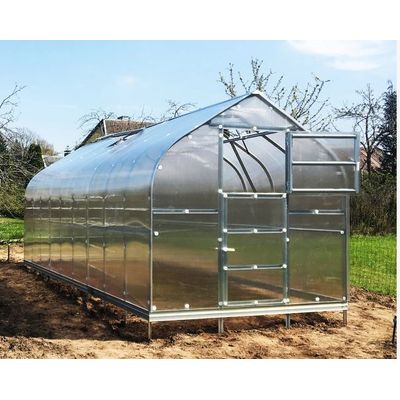
The greenhouse has a double door at one end and a hatch with an automatic opener on the roof. In addition, aisle separators, tables, additional hatches, additional doors, a partition inside the greenhouse, watering system can be purchased. The greenhouse is easy to install, each profile is numbered and the instruction is with a photo for each mounting step.
- Height – 2.45 m
- Width – 2.50 m
- Length – 2.00 m; 4.00 m; 6.00 m; 8.00 m
The set will include:
- Galvanized steel profiles – 1 mm thick; 56 mm wide; profiles zinc thickness 275 gr / m2 (frame profiles with anchors to dig in 40 cm in the ground)
- Basics (10 cm high, made of galvanized metal 1mm thick)
- All necessary fasteners – screws and washers
- Rubber sealing (to protect polycarbonate ducts from dust and dirt)
- 1 hatch
- 1 automatic hatch opening
- Installation instructions with pictures. (plus each profile is numbered to make it easier to assemble the frame)
The most important aspects of our solid greenhouses involve the foundation, footer, and flooring. These all imply the same thing. Most individuals are unsure of the appropriate sort of foundation to use and the necessary ground preparation steps. The most common question we get from potential greenhouse customers is, "Do I need to construct a foundation?" The reason you`ve come to this page is that we have the answers you need. Starting with the greenhouse foundation, flooring, and ground preparation is one of the most vital steps in any greenhouse project. Let’s have a look at our Solid Greenhouse solutions.
Importance of Solid Greenhouse Foundations
If your new greenhouse is built on top of a foundation, it won`t collapse like a house of cards in high winds and storms. Foundation provides a stable base for the greenhouse in all-weather circumstances by providing a load-bearing substructure The foundation serves a variety of purposes. To support the weight of the greenhouse, the structure must be able to endure both its own weight and that of the greenhouse itself. The strain imposed on the foundation is just too tremendous to allow the foundation to continue drilling into the earth. As a bonus, a foundation prevents the greenhouse from losing too much heat to the ground, making it easier to keep the temperature stable.
Why Choose a Solid Base Greenhouse
Our greenhouses placed on concrete/stone or brick foundations will often outlive the less durable buildings you normally find in gardens. The concrete/stone foundation does not have to extend much above the ground level. In certain cases, the bottom of your Glasshouse is encased in multiple layers of masonry, creating a modesty screen. Some of the most popular half-brick greenhouses we carry have a semi-walled look. Solid Greenhouses benefit from a low-level concrete/stone or brick wall. Greenhouse supplies and ground-level plants may also be kept out of the way. While acting as an absorber of solar heat by day and heat sink by night, concrete, stone, or brick walls also serve as a thermal mass, releasing heat into the solid foundation Greenhouse throughout the day.
The Advantage of our Solid Greenhouses
Solid greenhouses have adequate drainage, are simple to build, and do not need an excessive amount of specialist equipment and machinery. In addition to this, they are renowned for being one of the most economical greenhouse solutions.
The Disadvantages of Solid Greenhouses
This option is better suited for greenhouses that are on the smaller side or greenhouses that have foundation frames. In most cases, they do not provide the same level of protection from the wind, unless the foundation structure is very strong. In general, they need more upkeep to maintain the soil level, and they may be dirty if you don`t use flooring in addition to them.