


- Home
- Companies
- Briggs Irrigation
- Products
- Briggs - Model R46 - Hosereel Mounted ...
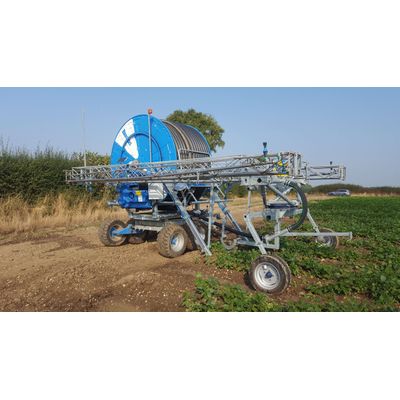
Briggs - Model R46 -Hosereel Mounted Booms for Agriculture and Horticulture
Designed and built to the same high standards as Briggs` larger models, the R46/35, R46/40 and R46/46 mounted booms allow a lane spacing of 35 - 66 metres. For ease of operation the booms are transported on the hosereel and a fixed hydraulic lift system has been developed to transport the booms safely. All models give accurate and uniform water distribution under a wide range of conditions, with a controlled droplet size to match the crop. The booms operate at low pressure (0.6 - 4 bar) and can apply from 25 to 60 cubic metres per hour.
- Uniform water application gives far more even crop growth compared to raingun systems.
- Using a Briggs boom can reduce water consumption by 20% compared with rainguns.
- High flow rates allow faster retraction enabling large areas to be covered in less time.
- Controlled droplet size reduces soil damage. Large droplets can be selected to reduce drift while fine droplets can be used to minimise damage to very delicate crops.
- Reduced impact from small droplets also reduces soil capping and soil erosion.
- Low pressure operation helps reduce pumping costs and puts less strain on the pipeline.
- The rear wheels of the boom can be set from 1.5 to 4.4m wide so that all the wheels are in a tractor wheeling.
- The boom is fully mounted on the hosereel, making transportation very simple.
- Genuine one person operation. From fully open to fully folded takes one operator 2 – 3 minutes.
- There is a choice of Nelson S3000 Sprayjets or R3000 Rotators configured to suit flow rates and droplet size requirements of the soil and crop.
- Pressure regulators are used on all Nelson S3000 or R3000 nozzle assemblies ensuring a perfectly matched flow rate across all nozzles.
- Ball valve control on all sprinkler/spray-jet outlets enables sections to be shut off to suit irrigation requirements and allows individual nozzles to be unblocked if necessary.
- Optional combination of sprinklers and spray jets or drop pipes and spray jets to suit wide headlands and irregular shaped fields.
- A choice of blanking plates, raingun mounting kits and end sprinklers give the booms exceptional versatility.
- In the design process strength, longevity and user friendliness were the top 3 items on the brief. These booms are designed to last as long as the hosereel they are working with.
- Proven lifespan of more than 20 years. Many booms from the late 1990`s are still working well with well with over 15000 hours of use.
- These booms are made from a combination of mild steel (fully galvanised) and stainless steel on the outer sections which ensures a long life span.
- All components are manufactured using modern technology and spares are readily available for any boom we have ever made.
- Models currently available include the R46/35, R46/40 & R46/46 (the second number designates structural length in metres).
- Options developed in conjunction with farmers around the world make the booms highly versatile.
- Larger diameter tubes throughout the chassis and the boom sections allowing for higher flow rates and minimal pressure loss.
- Stainless steel 3rd and 4th sections on the models R46/40 and R46/46 for excellent strength to weight ratio.
- Designed to be able to move from run to run in the fully open position. You do not have to fold the sections in between runs.
- The boom can be set at an angle of up to 30 degrees on the turntable. It can not be fully rotated.
- Designed to mount on to larger hosereel machines (compared to smaller booms). Minimum size hosereel is approximately 90/400 to have enough core weight to balance when the boom is rotated on the drum to line up with the run - guide below
- R46/35 - smallest hosereel 90/400
- R46/40 - smallest hosereel 90/400
- R46/46 - smallest hosereel 90/400
Offset (Asymetric) Waterfeed
For crops where you can not have the PE pipe in the middle of the row, the chassis can be supplied with offset (asymetric) waterfeed - left or right. (Left hand is shown in the photo) Track width can be set from 1.5 to 2.2m.
Slurry spec chassis
For booms which are used throughout the year for waste water disposal (sometimes in less than perfect conditions) this chassis offers lower ground pressure and a larger front wheel.
Blanking plate
Blanking plate with or without end sprinkler allows the boom width to be reduced to avoid awkward obstacles.
End sprinklers
The option of a low trajectory impact sprinkler on each end of the boom gives up to 35% increase in lane spacing. (not available on R46/46)
Nelson R55A end part circle rotator
Nelson R55VT part circle rotator can increase the lane spacing by 10-12 metres on each end of the boom. Droplet size is generally heavier than the S3000 or R3000 nozzles.
Dribble pipe
The dribble pipe option provides precise irrigation without wetting the crop. Drop pipe spacing can be engineered to suit individual planting systems. Each drop tube has a Nelson pressure regulator, nozzle and dropper with weight to allow precise inter row irrigation. (Available up to a maximum irrigation width of 35m)
Slurry splash plate nozzles
Available for separated liquids with a higher dry matter content (up to 4 or 5%).Nozzle size from 9mm to 16mm
Lift frame kits
Available for the range of Ocmis, Marani & Irtec hosereel machines
Filter cone and housing
Available in 3, 3.5 or 4" sizes with Bauer couplings. Filter should be used between the flexible hosereel supply pipe and the inlet fitting on the hosereel.
Dual Nozzle Clip
Holds two sizes of nozzle so that the boom can quickly be set to a different flow rate by swapping nozzles.
Turf wheels
Ideal for turf growers and amenity applications.
Three point linkage pulling out bar
Necessary for pulling out booms where the PE pipe is laid down in the wheeling behind one of the tractor wheels.
Manual raingun mounting kit
Used in two different ways:
- To irrigate an area that can not be reached with the sprayjets or rotators and then manually divert the water back to the boom for the remainder of the irrigation run.
- To allow the operator to use a raingun for the whole run or part of a run – if there is an obstacle in the way or a narrow part of the field to irrigate.