


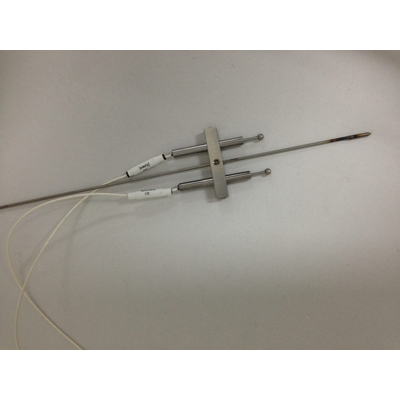
ICT - Model DEN5 -Dendrometer for Differential Measurement
The DEN5 is capable of measuring Xylem and phloem tissue diameter and thickness fluctuations and is ideal for extracting information about vessel refilling and embolism repair of the xylem, and the phloem transport of water and sugar.
With measurements in millimetres, and a resolution of 0.001 mm, the range is between 0-6mm.
The DEN5 use a pair of Differential Variable Reluctance Transducers (DVRT) to measure the fluctuations in the xylem and phloem tissue. These DVRTs, mounted in a stabilised frame, are secured to the heartwood of the tree using a thermally independent invar-36 rod. This removes the effects of thermal change on the measurement, providing an accurate measurement of the phloem and xylem.
With a DVRT mounted against the bark (insulated with a thin film of silicone vacuum grease) and one against exposed xylem (again insulated with silicone vacuum grease), the changes in the xylem and phloem can be calculated. This data is stored on the logger’s internal MicroSD card for downloading as a CSV file.
The radial dendrometer inserts into the tree along a single axis, allowing shrinking and swelling of plant tissues to be observed. The radial dendrometer creates a point of reference by locking itself in at the centre of the tree, or at a depth that encompasses the active outer radius of the tree. It then uses dual displacement transducers to measure diameter fluctuations in both xylem and phloem tissue which indicate tissue fluid pressures, thus providing information about sugar and water transport and status. Changes in diameter also indicate overall growth.
Applications
- Daily, seasonal and long-term changes in stem diameter
- Differentiate xylem and phloem tissue dynamics
- Vessel refilling & embolism repair
- Comparing carbon sequestration rates by species and by site
- Scheduling irrigation of horticultural tree & vine crops
The Differential Variable Reluctance Transducers or DVRT’s are fixed to a small, custom design mounting frame that attaches to a single radial arm or rod that is secured to the thermally and hydraulically stable heartwood of the tree.
The primary DVRT is positioned on the bark surface of the tree and the secondary DVRT against the xylem where the bark tissues have been removed. High grade alloys are chosen for minimal thermal expansion characteristics that largely eliminate thermal disturbance. Ambient thermal disturbance is further minimised because the bulk of the device is embedded in the tree, coupling the dendrometer to the stable thermal regime of the tree being measured. All sensing elements are interfaced with a 24-bit microprocessor to provide a calibrated digital output in engineering units, millimeters (mm)
Instrument DesignThe High Resolution Tree Growth Meter is simple to install and very accurate. The DEN5 can operate as a standalone logging dendrometer or can be wirelessly linked into a larger and highly modular logging network using the MCC2G Data Hub. Such independence means multiple trees throughout an experimental site can be continuously logged over a much larger area than if they were required to be connected to traditional analogue data logger, where all sensors are fitted with individual cables of maximum 10m lengths, and routed back to a centralised point. Small trees, large trees, neighbouring trees or very distant trees can now easily be measured without physically limiting experimental design constraints. Tree growth rate data becomes more accurate because a larger spatial average can be made as well as replication across a large range of trees and size classes.
Developed by Dr. Stephen Burgess during woodland and forest studies at the University of Western Australia, the radial dendrometer consists of a single, Invar-36 rod with a threaded tip that is secured into the heartwood of the tree to provide a measurement reference point.
The rod is inserted via a 3.18 mm (1/8inch) hole drilled into the tree and securely screwed into position. Two DVRT’s are secured into the mounting plate either side of the radial arm which is also fixed to the mounting plate. One DVRT is in touch with the bark and the other in contact with the xylem. It is important that no living material or bark touch the tip of the D2 Xylem DVRT as this will introduce a measurement error. Therefore the tissue must be removed and the DVRT and xylem coated in a thin film of silicone vacuum grease to prevent artificial drying at the site of measurement.
Data OutputThe basic sensor output is the measure of an increase in stem diameter in millimeters (with 1 µm or 0.001 mm resolution). Provided the starting diameter and depth of insertion into the tree are entered into the instrument as configuration parameters, the DEN5 can also output; total stem circumference, stem diameter, xylem diameter, Phloem diameter. Daily Maximum, and minimum diameters are recorded and maximum Daily Shrinkage automatically calculated and logged.