

- Home
- Companies
- Ditta Selvatici Srl
- Products
- Ditta - Model 150.150 Series - Spading ...
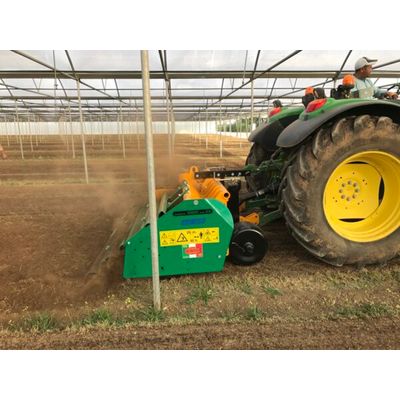
Ditta - Model 150.150 Series -Spading Machine
They are equipped with an anti-clogging frame with a differentiated structure. The exclusive three-point hitch with variable distance allows you to position the spading machine closer to the tractor: easier manoeuvres - less effort for lifting, more safety and especially in the most critical conditions. Min/max depth 10/35 cm.
STANDARD EQUIPMENT:
- THREE-POINT HITCH WITH VARIABLE DISTANCE CAT II
- PROTECTED PTO SHAFT WITH CLUTCH
- DEPTH ADJUSTMENT SLIDES 18 cm
- 3-SPEED LEVER GEAR SHIFT (M9.5 HELICOIDAL) PdF 540 = I 147 II 167 III 204 or PdF 1000= I 140 II 163 III 206
- GREASE LUBRICATED ROLLER BEARINGS
- ADJUSTABLE SPUR HOOD/LEVELER
- ADJUSTABLE LEVELER
FREE VARIABLES
- ADJUSTABLE SPUR HOOD/LEVELER
- REMOVABLE LEVELER h 30 FOR SPERON COFANO.
- HYDRAULIC ADJUSTMENT FOR SPUR HOOD
- POSTERIOR EXIT PdF13/8Z6
- LUBRICATION OF CONNECTING RODS WITH STEEL SEALS
- DOUBLE TOP HOOD
- LEVELER EXTENSION
- LATERAL SPILLWAYS
- LONG SPADES FOR SANDY SOILS
- ROUND SPADES FOR SOILS WITH STONES
- WIDE SPADES FOR PADDY/KIWI FIELDS
- 2 FOREQUARTERS H15/45 cm 6/18 inc.
- SLIDES WIDTH 40 cm
- REAR THREE-POINT ATTACHMENT +kg 150/Lbs 331 – cat II
- SUPPORT WHEELS (see below)
General characteristics of spading machines: - facilitating soil drainage and reducing the risk of slope runoff since that hard sole is not created under the tilled soil, a negative feature of other rotary or trailed implements. - tilling is done evenly across the width of the machine by evenly turning the soil so that fertilizer, manure or stubble can be buried. - the tilled soil has a flat surface, and the clods are of regular size so much so that sowing can often already be done directly. - the tools enter the soil one at a time, which allows for minimal tractor energy use and their durability is longer because they only work as they descend. - the spader is not towed by the tractor; on the contrary, it aids its advance so much so that this is the only implement that can work in wet soils because the tractor does not risk getting bogged down (since the demand for tractor wheel traction is minimal) and, in sloping terrain, in addition to helping the tractor advance, it keeps it in a stable position. It also reduces fuel consumption compared to traditional tillage such as plowing, ripping, and milling. - does not form the compact, impermeable soil layer underneath that prevents both greater root development and regular water runoff, so it does not trigger, especially on hillsides, dangerous slippage of tilled soil. - always ensures that clods are turned over and thus allows both faster aeration of the soil and the elimination, right from the roots, of harmful weeds. - requiring no tractive or braking effort from the tractor, it can be used even on steep slopes without any problem and in complete safety.