

- Home
- Companies
- Cimbria A/S - part of AGCO Corporation
- Products
- Selekta - Opto Electronic Sorters
Selekta - Opto Electronic Sorters
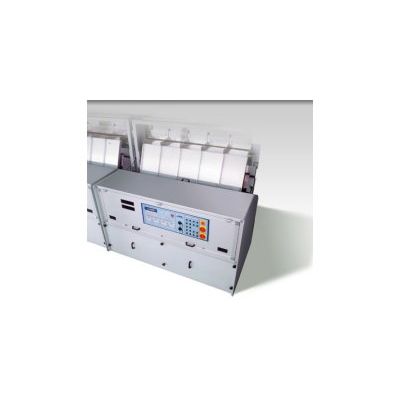
The quality standard is of key-importance since it corresponds to the first and foremost parameter required by end-consumers: consequently producers have more and more focused their attention to its constant preservation and improvement. A product provided with a quality guarantee is obviously highly preferred by users/consumers. SELEKTA opto-electronic sorters offer a fast and safe solution to such a requirement. The product presenting a non-conforming color in respect to the preset parameters is perfectly detected by the optical system of the SELEKTA sorters and automatically rejected with the maximum precision. Since 1968 SEA has been designing and supplying electronic sorters for different application fields (foodstuff plastics, minerals, glass recycling, and others) with over 1,500 sorters installed world.
- Control and separation of the contaminants contained in the stream through their colour difference with respect to the pre-established one.
- Control and separation of the opaque from transparent materials.
- Separation of motley streams into homogeneous fractions.
- 30 different sorting programs.
- Quick return of the investment.
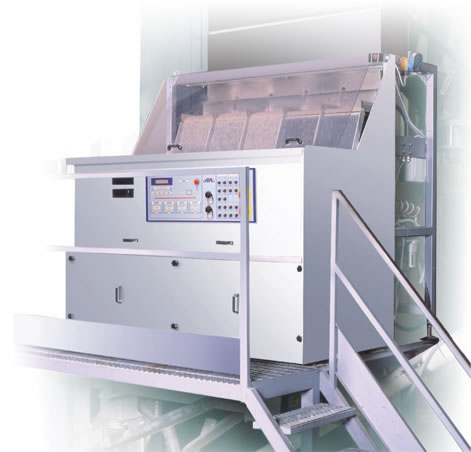
The sorting process of our SELEKTA sorters is extremely simple: Through a vibrating feeder the product to sort is conveyed to the optical section where each single particle is scanned many times. The sensors convert the image into digital information. The relevant digital information is then compared to the data stored in the memory. Once the characteristics of the single analyzed element have been identified, a high precision ejector, shunts the non-conforming piece off to a reject hopper, whereas the "good" element is allowed to continue to the good product hopper.
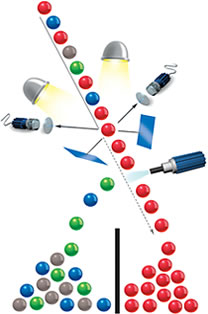
Automatic re-pass
SELEKTA sorters can be divided in two separate and independent sections working at the same time. The first section is used for input product sorting in order to get the sorted product on one side and the rejected product on the other; this latter is composed of unwanted particles and some "good" product. Should the input product contain a high contamination rate, the second section of the machine can be used for an additional run of the product already sorted in the first section. The second section can also be used to recover the good product rejected together with the impurities of the first section.
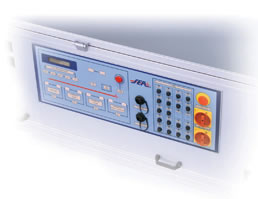
Simplified handling: more than 35 years of experience in manufacturing color sorters and in the application of electronics to the separation technology have enabled SEA to reach outstanding results with its versatile and precise SELEKTA sorting machines.
Versatility: thanks to microprocessors and to a sophisticated software, it is possible to make use of up to 30 different custom-made sorting programs.
Microprocessor Control: SEA color sorters are controlled by microprocessors allowing the use of specific functions such as the auto-diagnosis, the auto-setting, and the storage of the programs according to the specific production requirements. Very powerful microprocessors together with the SEA-software and the special sensors guarantee a perfect functioning ensuring the best results. SELEKTA sorters are manufactured in stainless steel and anodized aluminum. The controls and fuse panel are air- and water-tight and the operator has everything conveniently at hand. Inside the optical box, forced ventilation heaters and a thermostat control the temperature
Double Section: SEA sorters can be divided in two separate sections so that to carry out two different sorting processes at the same time.
Feeding: Specific feeding chutes or channels are used for different products in order to grant their best feeding to the sorter’s detection unit. The loading hopper can be provided with minimum, medium and maximum level sensors controlling the vibrators’ speed thus warranting the continuous stream of product into the machine.
Automatic cleaning system: SELEKTA sorters are featured by an automatic cleaning system inside the sealed optical box. A brush activated by a piston cleans the glass that protects the optical sensors: the continuous proper functioning of the machine is thus guaranteed.