
- Home
- Companies
- Industrial Plankton Inc.
- Articles
- Light Intensity
Light Intensity
Microalgae Growth: Light Intensity
Microalgae growth tends to have a consistent relationship with light intensity. Even though light is a key ingredient in photosynthesis, it does not necessarily mean that more light will always yield greater productivity. In the illustrated graph (Fig. 1), the actual growth rates and intensities at different points along the blue curve vary with many factors, but the general shape remains consistent.
At low light intensities, algae are limited by light availability, and increasing light availability will increase microalgae growth. At some point, increasing the light further will not affect the growth rate, as any additional light added in this saturated section of the curve will not be used. In contrast, at some point beyond that, excess light can start to damage cells (photoinhibition) and actually reduce growth rate.
How to Achieve Even Light Supply in a Dense Culture?
By mixing your culture and increasing the ratio of lit surface area to culture volume, you can increase the fraction of cells that receive enough light for photosynthesis. For example, the PBR 1250 L uses a high-surface-area tank geometry and continuous culture mixing to achieve this.
Yet another consideration: acclimation. You have to consider what your cells are used to. Cells that are used to growing in high light can tolerate high light, while cells that are used to low light will be more easily photoinhibited. So, the best way to determine how much light to use for your algae culture is to experiment.
So, start low (<150 umol photons m2 s-1) to avoid photoinhibition, especially if you have just diluted or inoculated. Try turning the lights up a little bit at a time as your culture gets denser and acclimates to its new conditions. And keep an eye on how it responds to the light increase.
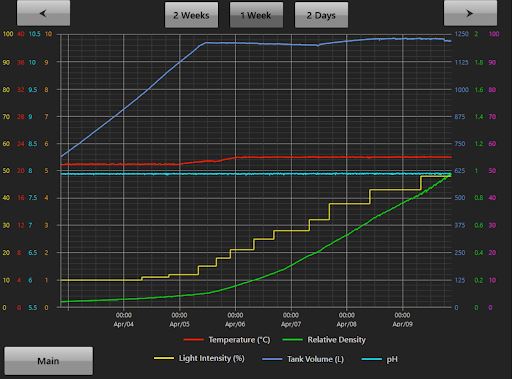
Industrial Plankton manufacturers and supplies PBR 1250L, where you can adjust conditions and watch growth parameters change in real time. Explore more algae production equipment here.
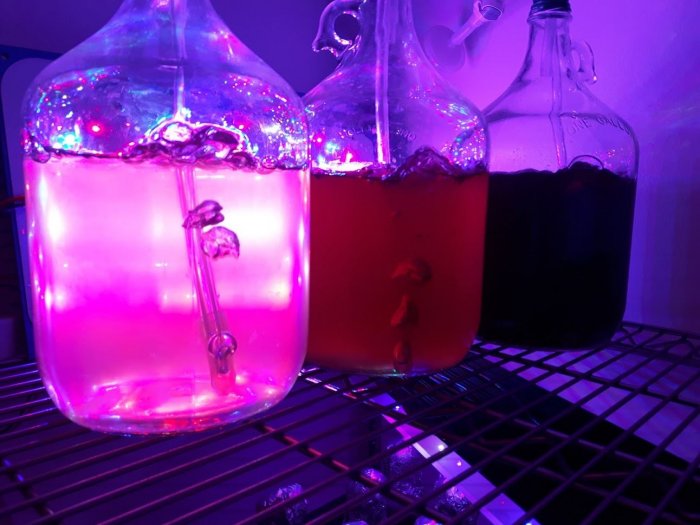
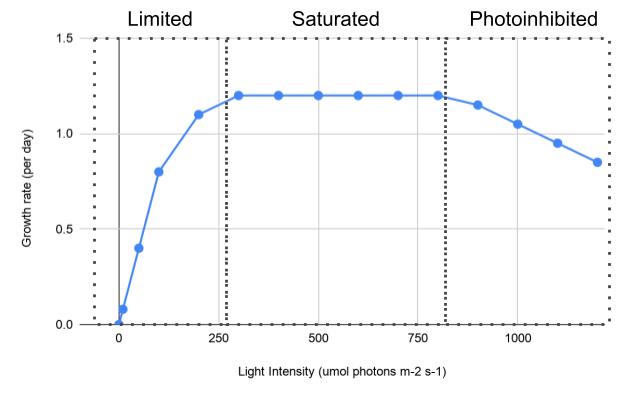
An important caveat for experiments like these is that they are usually performed with small culture volumes (e.g., 50 mL tubes). In larger-scale algae cultures, the light environment is much more complicated as the concentration increases.
As light travels through an algae culture, it is absorbed. This decrease in light depends on the concentration of algae cells present and on the “path length”, the distance from the light source to an algae cell. As shown in the Industrial Plankton in-house PBR 1250L Nannochloropsis oculata culture data, the decrease in light intensity is exponential with concentration (Fig. 4).
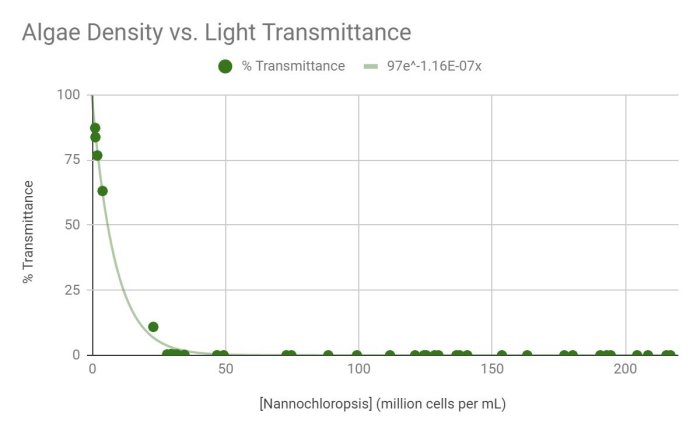
This means that when a culture is freshly inoculated, lots of the light will pass through, deep into the culture. But by the time the culture has become a bit denser (e.g., 30 million cells per mL), very little light will penetrate beyond the first few centimetres.