

- Home
- Companies
- Industrial Plankton Inc.
- Articles
- Microalgae Growth: Light Spectrum
Microalgae Growth: Light Spectrum
How Important is the Light Spectrum in Microalgae Growth?
Microalgae need light to grow and photosynthesize, but not all light is created equal. The spectrum of light can significantly affect how well your algae grows.
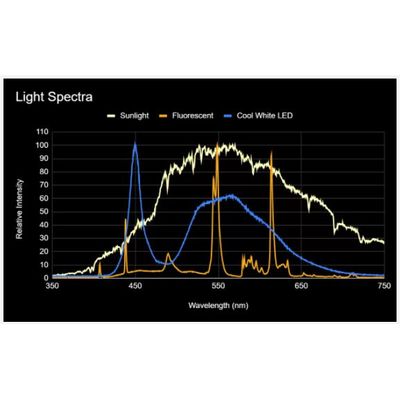
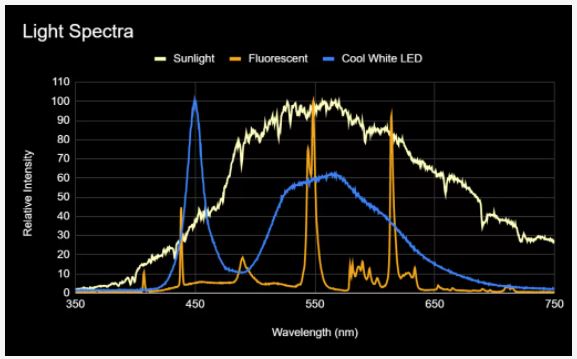
The spectrum of a light is how bright it is at different wavelengths. This can be closely related to colour; e.g., a red LED appears red because it emits light at 650 nm. However, differences in light spectra can also be hard to distinguish with the human eye. For example, in the figure below (Fig. 1), I’ve plotted three different “white” light sources: the sun, a fluorescent bulb, and a cool white LED. As you can see, they have pretty distinct spectral profiles.
Why does this Matter for Microalgae?
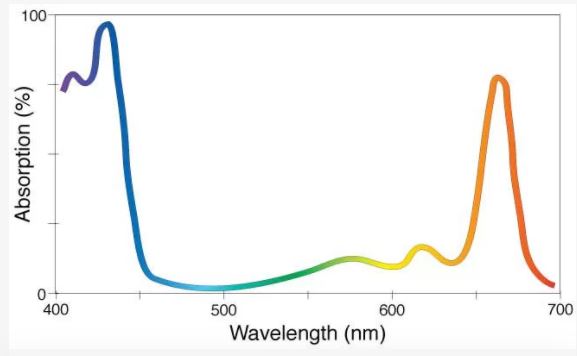
All algae use the pigment chlorophyll a to carry out photosynthesis. As you can see from the profile of chlorophyll a absorbance (Fig. 2), it is particularly good at absorbing light in the red and blue parts of the spectrum. This is why so many grow lights have lots of red and blue light (including the LED panels in our PBR).
In reality, all microalgae have other pigments in addition to chlorophyll a. Most of these pigments broaden the absorption spectrum beyond the peaks of chlorophyll a in the red and blue (Fig. 3). The specific pigment complement a species has depends on which branch of the evolutionary tree it comes from.
How the Microalgae Absorption Spectra Works?
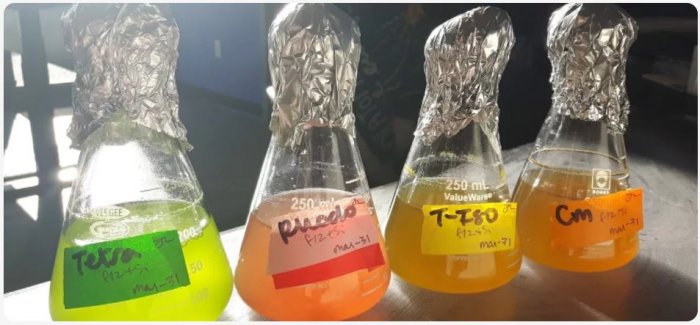
The absorption spectra in Figure 3 were measured for the same algae as in the flasks in the image above. Can you see how the absorption spectra relate to the algae's colour? The colours of light that are not well absorbed are reflected so that we can see them, for example, green for Tetraselmis, reddish for Rhodomonas and yellowish brown for both Chaetoceros and Tisochrysis.
What to Consider When Choosing Lights for Algae Growth?
When growing algae, it is essential to consider the strain you are growing, as some of them might have different reactions to certain types of lights, yet three primary colours are very well suited for boosting algae growth, such as:
White sunlight has a broad spectrum, so that white light can work for all species. Note that different “white” light sources may have different spectra, and few replicate the broad output of natural sunlight.
Red and blue: are strongly absorbed by all microalgae and tend to yield the fastest growth rates for most species.
Other colours: may be absorbed well or poorly, depending on the species. It can be essential for specific applications, e.g. production of particular pigments.
For more information about how light spectrum affects algae growth, check out the “Managing Spectral Distribution” section of Ooms et al. (2016).
Industrial Plankton manufacturers and supplies PBR 1250L, where you can adjust conditions and watch growth parameters change in real time to ensure optimal conditions. Explore more algae production equipment here.