

- Home
- Companies
- Industrial Plankton Inc.
- Articles
- Photobioreactors: Advantages & ...
Photobioreactors: Advantages & Disadvantages
What are open and closed algae culture systems?
Open algae culture systems and closed photobioreactors (PBRs) are the two broadest methods for culturing microalgae at medium to large scale, and the advantages and disadvantages depend on your microalgae cultivation goals. A PBR is any device or system that supports the culture of photosynthetic organisms using light.
In any type of algae production, light penetration, light path and surface area to volume ratio all affect the density that can be achieved and overall productivity (algae produced) of the system:
- The further light can penetrate a culture, the more algal cells that can be sufficiently lit to replicate and grow. However, as cell density increases, more light is absorbed, and then it penetrates a shorter distance within the culture.
- A shorter light path through cultures is beneficial to density, as it allows light to reach a larger proportion of the culture, enabling more algae cells to replicate.
- A system with a higher surface area-to-volume ratio is beneficial for the same reason.
- All these factors have critical implications for the design of any algae cultivation system and shape how open and closed systems are used. In general, open algae cultivation systems tend towards higher volume and lower density, while closed PBR systems tend towards lower volume and higher density.
How to identify an open algae culture system?
Open algae cultivation systems are defined by their exposure to the outside environment, which leads to lower operational cost but minimal control over culture parameters such as :
- Temperature
- Light
- pH
- Others
They generally culture microalgae at lower densities than closed PBR systems, require more space to be economical, and are more prone to contamination. This is a significant disadvantage in microalgae production.
Some vectors for contaminants in open systems are:
- Ambient Air
- Rain
- Ocean spray
- Staff
- Wild animals
Common contaminants, such as algal predators (zooplankton), bacteria, and even competing strains, can all reduce production efficiency or even spoil cultures. This leads most open culture systems to operate in various forms of batch production, where microalgae are grown for a short period and can outcompete the inherent contaminants until harvested.
Being generally larger and simpler systems, they tend to be much cheaper to set up, proportional to volume; however, the densities achieved are often lower with higher levels of contaminants, leading to large land requirements. This highlights the key advantages and disadvantages of these photobioreactor systems. Some examples of open cultures used in microalgae production are:
- Raceway Ponds
- Fiberglass Tanks
- Artificial Ponds
What are Raceway Ponds?
Raceway ponds are open algae cultivation systems prone to contamination, so whatever you’re doing downstream with the microalgae needs to be tolerant to some level of contamination, not to mention that, due to their large volume, they require large volumes of clean inoculum.
Open raceway ponds saw widespread adoption during the algae-biofuel boom in the early 2000s. They require large tracts of land due to their low water level, but can be very cost-effective when operated effectively, a key advantage for large-scale microalgae production.
These are ponds that use:
- Short walls and paddle wheels to move a shallow pool of microalgae around an oval route. The culture depth is usually limited to about 1 ft (30 cm) to allow the sun to illuminate it efficiently.
- They require large tracts of land due to their low water level, but can be very cost-effective when operated effectively.
What are Fibreglass Tanks?
Fibreglass tanks or kawall tubes are typically cylindrical and aerated from the bottom to facilitate mixing and gas exchange, which are necessary for algae cultures. By using clear fibreglass, the sidewalls, in addition to the top surface, can be illuminated for photosynthesis.
They tend to be taller than they are wide, but almost all are much deeper than raceway ponds and have lower surface area-to-volume ratios because of the higher water level. This limits their density.
Sizes can range from tens of litres to tens of thousands of litres. Due to the low cost of materials and their simplicity, open fibreglass tank culture is widely used in aquaculture, particularly in regions where labour is cheap, as these tanks require significant labour to maintain (filling, inoculating, emptying, and cleaning on a 3-4 day cycle). This labour requirement is a distinct disadvantage.
If they are well managed and inoculated with a good inoculum culture, batch microalgae production in fibreglass tanks can yield significant amounts of algae, albeit with a fair bit of effort and space, at a relatively low cost.
What are Artificial Ponds?
Artificial ponds have opaque side walls or are dug into the ground. This allows for cheaper construction but limits the illuminated surface area. Because of this, they tend toward squatter tanks (like raceway ponds).
They can use pond liners, concrete, or simply a hole in the ground. They are often very labour-intensive and require a lot of chemicals to operate appropriately. Adding to operational disadvantages.
Overall, open algae culture systems typically run for shorter periods because they cannot operate continuously; however, when expertly managed, they can be very cost-effective for large-scale microalgae production.
What are the Characteristics of Close Bioreactors (PBRs)?
In a diatom pun, closed algae systems are those in which inputs are controlled, and algae are grown in an enclosed environment. There is a wide variety of closed photobioreactors (PBRs). Many vital microalgae parameters can only be controlled in closed PBR systems.
Closed PBRs can use artificial or natural light and are generally more expensive initially than open algae cultivation systems; however, because they are closed, they can operate continuously for varying lengths of time. This continuous operation is a significant advantage in microalgae production. Some of the closed systems PBR include:
- Tubular PBRs
- Single-use bag PBRs
- flat panel PBRs
- Internally illuminated PBRs
- Industrial Plankton PBRs
What are Tubular Photobioreactors?
Tubular photobioreactors are made of a series of narrow-diameter (2-8 in) transparent tubes connected to a reservoir and a pump that circulates the media (nutrients and water) and microalgae. They are most cost-effectively lit with natural sunlight, but can also use artificial lighting when natural light is limited. Because the light path is so short, they can achieve high-density cultures.
As a result, they have become very popular for mass-scale algae cultivation in the nutraceutical and biotech sectors, where algae-derived bioproducts require dewatering. Yet, they have limited temperature control unless installed in an air-conditioned building or equipped with coolant jackets, and the product must be purer for the end application.
These bioreactor systems can span acres and have an incredibly high surface-to-volume ratio. This makes for a lot of area to clean. They often utilize:
- Pigging, conceptually, is pumping a scrub brush through a pipe to remove biofilm from the tubing
- Large volumes of chemicals are used to clean between cultures.
What are Single-use bags?
Plastic Bag Photobioreactors are typically less expensive than other closed bioreactor systems in terms of upfront capital costs. The bags don’t have a structure of their own, so they usually require a wire mesh to support the bag or a frame to hang them from. There is generally no temperature control, so they are also limited in where they can operate.
The bags typically come gamma-irradiated or clean, simply because they are manufactured that way. This allows for a clean environment for culturing microalgae. However, media entering must be handled appropriately; otherwise, the culture will quickly become contaminated, and the bags must be discarded, a significant disadvantage.
These bioreactor systems rely on:
- Pasteurizers to treat the incoming water, which are very energy-intensive.
- Ag systems are delicate, and they can easily develop holes or tears around fitting penetrations or where bags are folded or sealed.
- They generally require skilled operators to get optimal production.
- Their densities are limited by their surface-to-volume ratio, leading to a wide range of bag shapes and sizes. Generally, this leads to a high number of replicates, meaning more floor space and labour.
What are Flatpanel Photobioreactors?
These bioreactor systems are generally constructed from either glass or transparent plastic, with a thin (~3-8 in) layer of media and microalgae laminated and aerated from the bottom.
- They have a very short light path, similar to tubular bioreactors.
- They have more challenging surfaces to clean due to their geometry; however, they can also easily develop a low-circulation dead zone.
What are Internally Lit Photobioreactors?
Internally lit PBRs are conceptually the opposite of tubular PBRs. Instead of placing small tubes of algae in lit areas, they introduced minor light intrusions into large volumes of algae. They can have transparent or opaque side walls, but most internally lit PBRs aerate the algae cultures from the bottom.
Due to mixing and a large surface area-to-volume ratio, these PBRs can achieve densities 10 to 20 times those of traditional bag or batch systems, a massive advantage for microalgae production. Like tubular PBRs, the high surface area-to-volume ratio created by the intrusion of light also provides a large area for cleaning because:
- The intrusion of lights in internally lit PBRs can be a nuisance unless they are equipped with an internal Clean-in-Place (CIP) system. Due to the central volume of algae, these systems can efficiently use heat exchangers to regulate culture temperatures automatically. This allows for a broader range of acceptable ambient temperatures for the PBRis installation, as well as a wider range of possible culture temperatures.
Like other closed PBRs, there is a higher capital investment; however, with high-density continuous culture, these PBRs pay back that investment through labour savings, lower operational costs, and enhanced biosecurity. This leads to countless downstream benefits for biotechnology research projects, hatcheries and overall microalgae production.
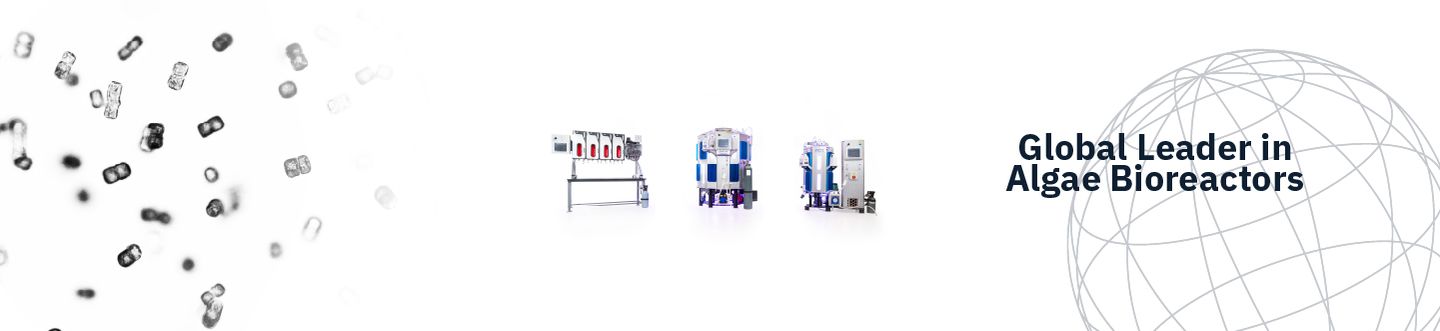
Now, Industrial Plankton Manufactures and supplies microalgae Bioreactors for researchers and industrial applications. Explore our production equipment here.